
|
You entered: dust
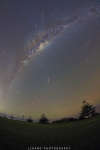 Halley Dust and Milky Way
9.05.2019
Grains of cosmic dust streaked through the mostly moonless night skies of May 7. Swept up as planet Earth plowed through the debris streams left behind by periodic Comet Halley, the annual meteor shower is known as the Eta Aquarids.
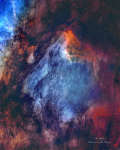 APOD: 2026 September 7 Б The Pelican Nebula in Gas, Dust, and Stars
6.09.2026
The Pelican Nebula is slowly being transformed. IC 5070 (an official designation) is divided from the larger North America Nebula by a molecular cloud filled with dark dust. The deep featured picture from Utah, USA incorporates 25 hours of exposure and brings out great details of this filamentary dust.
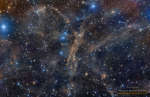 A Dust Angel Nebula
27.04.2016
The combined light of stars along the Milky Way are reflected by these cosmic dust clouds that soar some 300 light-years or so above the plane of our galaxy. Dubbed the Angel Nebula, the faint apparition is part of an expansive complex of dim and relatively unexplored, diffuse molecular clouds.
 APOD: 2023 November 26 Б A Dust Jet from the Surface of Comet 67P
25.11.2023
Where do comet tails come from? There are no obvious places on the nuclei of comets from which the jets that create comet tails emanate. In 2016, though, ESA's Rosetta spacecraft not only imaged a jet emerging from Comet 67P/Churyumov-Gerasimenko, but flew right through it.
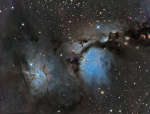 M78 and Reflecting Dust Clouds
26.03.2014
An eerie blue glow and ominous columns of dark dust highlight M78 and other bright reflection nebula in the constellation of Orion. The dark filamentary dust not only absorbs light, but also reflects the light of several bright blue stars that formed recently in the nebula.
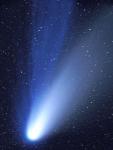 The Dust and Ion Tails of Comet Hale Bopp
26.12.2000
In 1977, Comet Hale-Bopp's intrinsic brightness exceeded any comet since 1811. Since it peaked on the other side of the Earth's orbit, however, the comet appeared only brighter than any comet in two decades. Visible above are the two tails shed by Comet Hale-Bopp.
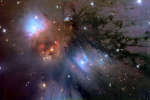 NGC 2170: Still Life with Reflecting Dust
7.07.2013
In this beautiful celestial still life composed with a cosmic brush, dusty nebula NGC 2170 shines at the upper left. Reflecting the light of nearby hot stars, NGC 2170 is joined by other bluish reflection nebulae, a compact red emission region, and streamers of obscuring dust against a backdrop of stars.
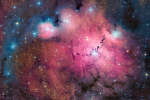 Simeis 188 in Stars, Dust and Gas
27.06.2012
When stars form, pandemonium reigns. A particularly colorful case is the star forming region Simeis 188 which houses an unusual and bright cloud arc cataloged as NGC 6559. Visible above are red glowing emission nebulas of hydrogen, blue reflection nebulas of dust, dark absorption nebulas of dust, and the stars that formed from them.
 APOD: 2023 December 6 Б Stars Verus Dust in the Carina Nebula
5.12.2023
It's stars versus dust in the Carina Nebula and the stars are winning. More precisely, the energetic light and winds from massive newly formed stars are evaporating and dispersing the dusty stellar nurseries in which they formed.
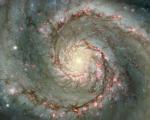 M51: The Whirlpool Galaxy in Dust and Stars
10.04.2001
The Whirlpool Galaxy is a classic spiral galaxy. At only 30 million light years distant and fully 60 thousand light years across, M51, also known as NGC 5194, is one of the brightest and most picturesque galaxies on the sky.
|
January February March April May June July August September |
|||||||||||||||||||||||||||||||||||||||||||||||||