
|
You entered: X-ray source
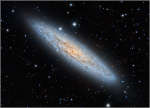 NGC 253: The Sculptor Galaxy
20.12.2011
NGC 253 is not only one of the brightest spiral galaxies visible, it is also one of the dustiest. Discovered in 1783 by Caroline Herschel in the constellation of Sculptor, NGC 253 lies only about ten million light-years distant.
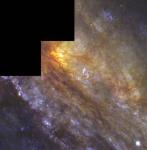 NGC 253: The Sculptor Galaxy
8.12.1998
NGC 253 is not only one of the brightest spiral galaxies visible, it is also one of the dustiest. Discovered in 1783 by Caroline Herschel in the constellation of Sculptor, NGC 253 lies only about ten million light-years distant.
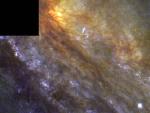 NGC 253: The Sculptor Galaxy
15.03.2003
NGC 253 is not only one of the brightest spiral galaxies visible, it is also one of the dustiest. Discovered in 1783 by Caroline Herschel in the constellation of Sculptor, NGC 253 lies only about ten million light-years distant.
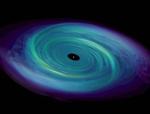 Accretion Disk Simulation
27.09.2002
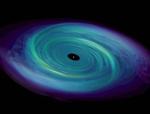
Don't be fooled by the familiar symmetry. The graceful spiral structure seen in this computer visualization does not portray winding spiral arms in a distant galaxy of stars. Instead, the graphic shows spiral...
 Accretion Disk Simulation
11.03.2005
Don't be fooled by the familiar pattern. The graceful spiral structure seen in this computer visualization does not portray winding spiral arms in a distant galaxy of stars. Instead, the graphic shows spiral...
 A Year of Resolving Backgrounds
29.12.2000
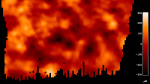
No matter which direction you look, no matter what type of light you see, the sky glows - but why? The sources of many of these background radiations have remained long-standing puzzles, but this millennial year brought some partial resolutions.
 Around The Arches Cluster
14.06.2001
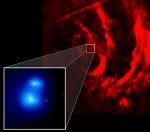
The most compact cluster of stars known in our galaxy, the Arches cluster, boasts 100 or so massive, young stars contained within a diameter of one light-year. Seen toward the constellation Sagittarius, the Arches...
 APOD: 2004 August 26- Cassiopeia A in a Million
26.08.2004
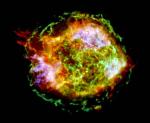
One million seconds of x-ray image data were used to construct this view of supernova remnant Cassiopeia A, the expanding debris cloud from a stellar explosion. The stunningly detailed image from the Chandra Observatory will allow an unprecedented exploration of the catastrophic fate that awaits stars much more massive than the Sun.
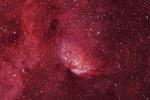 The Tulip in the Swan
24.05.2007
This expansive (1-degree wide) telescopic view looks out along the plane of our Milky Way Galaxy toward the nebula rich constellation Cygnus the Swan. It is centered on a bright hydrogen emission region recorded in the 1959 catalog by astronomer Stewart Sharpless as Sh2-101.
 A High Energy Fleet
24.02.1996
Looking like a fleet of futuristic starcruisers poised over planet Earth, NASA's highly successful series of High Energy Astrophysical Observatory (HEAO) spacecraft appear above in a vintage illustration. Labeled A, B, and C in this conceptual picture, the spacebased telescopes were known as HEAO-1, HEAO-2, and HEAO-3 respectively.
|
January February March April May June July August September October |
|||||||||||||||||||||||||||||||||||||||||||||||||