
|
You entered: TRACE
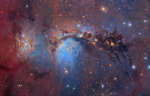 M78: Stardust and Starlight
10.10.2013
Interstellar dust clouds and bright nebulae abound in the fertile constellation of Orion. One of the brightest, M78, is just left of center in this colorful telescopic view, covering an area north of Orion's belt. At a distance of about 1,500 light-years, the bluish nebula itself is about 5 light-years across.
 APOD: 2024 December 15 Б Geminid Meteors over a Snowy Forest
15.12.2024
Meteors have been flowing out from the constellation Gemini. This was expected, as mid-December is the time of the Geminid Meteor Shower. Pictured here, over two dozen meteors were caught in successively added exposures taken over several hours early Saturday morning from a snowy forest in Poland.
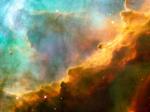 M17: A Hubble Close Up
25.04.2003
Sculpted by stellar winds and radiation, these fantastic, undulating shapes lie within the stellar nursery known as M17, the Omega Nebula, some 5,500 light-years away in the nebula-rich constellation Sagittarius. The lumpy features...
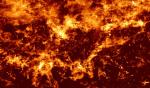 Billows of Smog in the Outer Galaxy
15.01.2001
Our Galaxy is filled with gas. Most of this gas is hydrogen, some is helium, but there is a trace amount of relatively heavy molecules, including carbon monoxide (CO) - a component of smog. The above wide-angle radio CO image shows the incredibly diverse structures that the molecular interstellar medium forms.
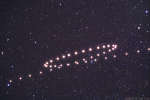 Retrograde Mars
13.06.2010
Why would Mars appear to move backwards? Most of the time, the apparent motion of Mars in Earth's sky is in one direction, slow but steady in front of the far distant stars. About every two years, however, the Earth passes Mars as they orbit around the Sun.
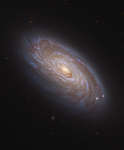 Messier 88
28.12.2022
Charles Messier described the 88th entry in his 18th century catalog of Nebulae and Star Clusters as a spiral nebula without stars. Of course the gorgeous M88 is now understood to be a galaxy full of stars, gas, and dust, not unlike our own Milky Way.
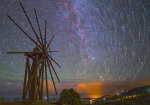 The Windmill and the Star Trails
17.04.2020
Stars can't turn these old wooden arms, but it does look like they might in this scene from a rotating planet. The well-composed night skyscape was recorded from Garafia, a municipality on the island of La Palma, Canary Islands, planet Earth.
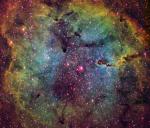 Emission Nebula IC 1396
5.08.2004
Sprawling across hundreds of light-years, emission nebula IC 1396 mixes glowing cosmic gas and dark dust clouds. Stars are forming in this area, only about 3,000 light-years from Earth. This particularly colorful view of the region is a composite of digital images recorded through narrow band filters.
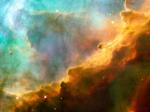 APOD: 2004 August 28- M17: A Hubble Close-Up
28.08.2004
Sculpted by stellar winds and radiation, these fantastic, undulating shapes lie within the stellar nursery known as M17, the Omega Nebula, some 5,500 light-years away in the nebula-rich constellation Sagittarius. The lumpy features...
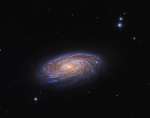 Messier 88
30.01.2010
Charles Messier described the 88th entry in his 18th century catalog of Nebulae and Star Clusters as a spiral nebula without stars. Of course the gorgeous M88 is now understood to be a galaxy full of stars, gas, and dust, not unlike our own Milky Way.
|
January February March April May June July August September |
|||||||||||||||||||||||||||||||||||||||||||||||||