
|
You entered: Spain
 APOD: 2024 April 29 Б Comet, Planet, Moon
28.04.2024
Three bright objects satisfied seasoned stargazers of the western sky just after sunset earlier this month. The most familiar was the Moon, seen on the upper left in a crescent phase. The rest of the Moon was faintly visible by sunlight first reflected by the Earth.
 APOD: 2023 August 8 Б Moon Meets Jupiter
7.08.2023
What's that below the Moon? Jupiter -- and its largest moons. Many skygazers across planet Earth enjoyed the close conjunction of Earth's Moon passing nearly in front of Jupiter in mid-June. The featured image is a single exposure of the event taken from MorцЁn de la Frontera, Spain.
 Comet McNaught Over Catalonia
14.01.2007
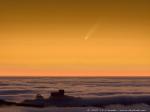
This past weekend Comet McNaught peaked at a brightness that surpassed even Venus. Fascinated sky enthusiasts in the Earth's northern hemisphere were treated to an instantly visible comet head and a faint elongated tail near sunrise and sunset.
 Zodiacal Road
23.07.2019
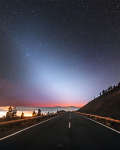
What's that strange light down the road? Dust orbiting the Sun. At certain times of the year, a band of sun-reflecting dust from the inner Solar System appears prominently just after sunset -- or just before sunrise -- and is called zodiacal light.
 Mercury on the Horizon
12.04.2003
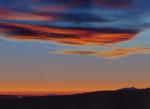
Have you ever seen the planet Mercury? Because Mercury orbits so close to the Sun, it never wanders far from the Sun in Earth's sky. If trailing the Sun, Mercury will be visible low on the horizon for only a short while before sunset.
 Sunrise Shadows in the Sky
20.09.2024
The defining astronomical moment of this September's equinox is at 12:44 UTC on September 22, when the Sun crosses the celestial equator moving south in its yearly journey through planet Earth's sky.
 Leonids Above Torre de la Guaita
11.12.2010
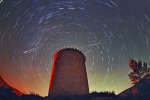
In 1999, Leonids Meteor Shower came to an impressive crescendo. Observers in Europe saw a sharp peak in the number of meteors visible around 0210 UTC during the early morning hours of November 18. Meteor counts then exceeded 1000 per hour - the minimum needed to define a true meteor storm.
 Meteors, Comet, and Big Dipper over La Palma
22.04.2019
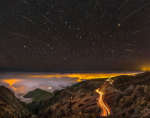
Meteor showers are caused by streams of solid particles, dust size and larger, moving as a group through space. In most cases, the orbits of these meteor streams can be identified with dust expelled from a comet.
 Mars Through a Small Telescope
19.08.2003
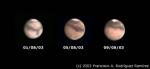
How does Mars appear through a small telescope? Viewed with the unaided eye or through a small telescope, possibly the most striking part of Mars' appearance is it's red color. The color derives from rust, iron oxide, which composes perhaps 10% of the Martian soil.
 APOD: 2025 May 21 Б International Space Station Crosses the Sun
20.05.2025
Typically, the International Space Station is visible only at night. Slowly drifting across the night sky as it orbits the Earth, the International Space Station (ISS) can be seen as a bright spot about once a month from many locations.
|
January February March April May June July August September October |
|||||||||||||||||||||||||||||||||||||||||||||||||