
|
You entered: Cepheus
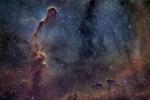 The Elephant s Trunk in IC 1396
18.10.2007
Like an illustration in a galactic Just So Story, the Elephant's Trunk Nebula winds through the emission nebula and young star cluster complex IC 1396, in the high and far off constellation of Cepheus. Of course, this cosmic elephant's trunk is over 20 light-years long.
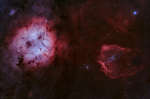 Elephant, Bat, and Squid
23.07.2021
Sprawling emission nebulae IC 1396 and Sh2-129 mix glowing interstellar gas and dark dust clouds in this 10 degree wide field of view toward the northern constellation Cepheus the King. Energized by its bluish central star IC 1396 (left) is hundreds of light-years across and some 3,000 light-years distant.
 Mu Cephei
12.10.2023
Mu Cephei is a very large star. An M-class supergiant some 1500 times the size of the Sun, it is one of the largest stars visible to the unaided eye, and even one of the largest in the entire Galaxy.
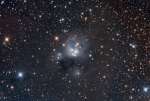 Young Suns of NGC 7129
3.10.2008
Young suns still lie within dusty NGC 7129, some 3,000 light-years away toward the royal constellation Cepheus. While these stars are at a relatively tender age, only about a million years old, it is likely that our own Sun formed in a similar stellar nursery some five billion years ago.
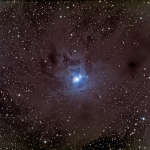 A Dusty Iris Nebula
10.06.2009
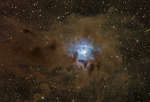
These clouds of interstellar dust and gas have blossomed 1,300 light-years away in the fertile star fields of the constellation Cepheus. Sometimes called the Iris Nebula and dutifully cataloged as NGC 7023, this is not the only nebula in the sky to evoke the imagery of flowers.
 A Dusty Iris Nebula
4.08.2011
These clouds of interstellar dust and gas have blossomed 1,300 light-years away in the fertile star fields of the constellation Cepheus. Sometimes called the Iris Nebula and dutifully cataloged as NGC 7023, this is not the only nebula in the sky to evoke the imagery of flowers.
 In Wolf s Cave
19.11.2011
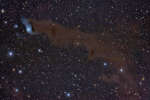
The mysterious blue reflection nebula found in catalogs as VdB 152 or Ced 201 really is very faint. It lies at the tip of the long dark nebula Barnard 175 in a dusty complex that has also been called Wolf's Cave.
 PanSTARRS: The Anti Tail Comet
29.06.2013
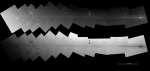
Once known as Earth's sunset comet, PanSTARRS (C/2011 L4) is up all night now, but only for northern hemisphere skygazers. Telescopes are required to track its progress as it fades and heads for the outer solar system.
 Ou4: The Giant Squid Nebula
12.10.2022
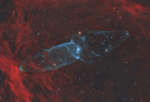
A mysterious squid-like cosmic cloud, this nebula is very faint, but also very large in planet Earth's sky. In the image, composed with 30 hours of narrowband image data, it spans nearly three full moons toward the royal constellation Cepheus.
 APOD: 2025 March 18 Б LDN 1235: The Shark Nebula
18.03.2025
There is no sea on Earth large enough to contain the Shark nebula. This predator apparition poses us no danger as it is composed only of interstellar gas and dust. Dark dust like that featured here is somewhat like cigarette smoke and created in the cool atmospheres of giant stars.
|
January February March April May June July August September October |
|||||||||||||||||||||||||||||||||||||||||||||||||