
|
You entered: dark cloud
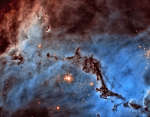 N11: Star Clouds of the LMC
11.02.2013
Massive stars, abrasive winds, mountains of dust, and energetic light sculpt one of the largest and most picturesque regions of star formation in the Local Group of Galaxies. Known as N11, the region...
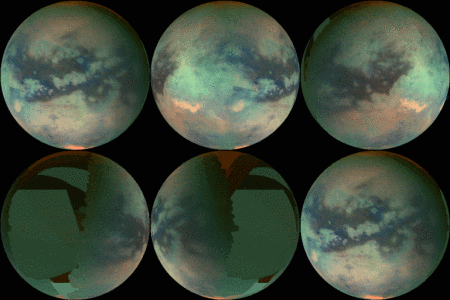 Rotating Titan in Infrared Light
14.02.2006
Titan is one of the strangest places in our Solar System. The only moon known with thick clouds, this unusual satellite of Saturn shows evidence of evaporating lakes created by methane rain. The clouds...
 APOD: 2024 May 11 Б AR 3664: Giant Sunspot Group
10.05.2024
Right now, one of the largest sunspot groups in recent history is crossing the Sun. Active Region 3664 is not only big -- it's violent, throwing off clouds of particles into the Solar System. Some of these CMEs are already impacting the Earth, and others might follow.
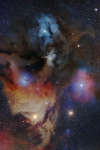 APOD: 2026 July 1 Б The Cotton Candy Clouds of Rho Ophiuchi
30.06.2026
Although they look like cotton candy, you cannot eat these clouds! Taken in Cádiz, Spain, today's image features the Rho Ophiuchi complex, a rich tapestry of young and old astronomical phenomena. This colorful cloud complex is a nearby star-forming region containing hundreds of young stellar objects, including protostars and T Tauri stars.
 The Gegenschein
25.12.2006
If you look carefully enough, you can even see the glow of the Sun in the opposite direction. At night this glow is known as the gegenschein (German for "counter glow"), and can be seen as a faint glow in an extremely dark sky. The gegenschein is sunlight back-scattered off small interplanetary dust particles.
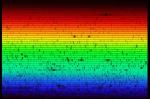 The Solar Spectrum
23.04.2006
It is still not known why the Sun's light is missing some colors. Shown above are all the visible colors of the Sun, produced by passing the Sun's light through a prism-like device.
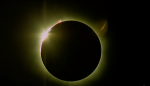 Cheering a Total Solar Eclipse
14.03.2016
What would you do if you saw the Sun disappear? Quite possibly: cheer. That's what many exuberant sky watchers did across Indonesia during a total eclipse of the Sun last week. There and then, the land and sky went dark during the day as our Sun disappeared for a few minutes behind our Moon.
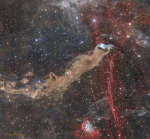 Wolfs Cave Nebula
14.11.2022
The mysterious blue reflection nebula found in catalogs as VdB 152 or Ced 201 really is very faint. It lies at the tip of the long dark nebula Barnard 175 in a dusty complex that has also been called Wolf's Cave.
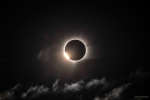 APOD: 2026 August 14 Б Total Solar Eclipse from Greenland
13.08.2026
On August 12, the Moon's shadow reached out to touch our fair planet. Beginning in the Arctic Ocean, it swept along a narrow track that led the dark lunar umbra across parts of Greenland, Iceland, the Atlantic, Portugal, and northern Spain.
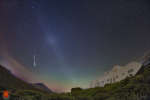 A Meteor and the Gegenschein
11.05.2021
Is the night sky darkest in the direction opposite the Sun? No. In fact, a rarely discernable faint glow known as the gegenschein (German for "counter glow") can be seen 180 degrees around from the Sun in an extremely dark sky. The gegenschein is sunlight back-scattered off small interplanetary dust particles.
|
January February March April May June July August September |
|||||||||||||||||||||||||||||||||||||||||||||||||