
|
You entered: Milky Way
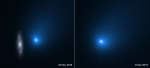 Interstellar Comet 2I Borisov
14.12.2019
From somewhere else in the Milky Way galaxy, Comet 2I/Borisov is just visiting the Solar System. Discovered by Crimean amateur astronomer Gennady Borisov on August 30, 2019, the first known interstellar comet is captured in these two recent Hubble Space Telescope images.
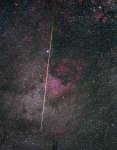 Lyrid Meteor Streak
23.04.2020
Earth's annual Lyrid Meteor Shower peaked before dawn yesterday, as our fair planet plowed through debris from the tail of long-period comet Thatcher. In crisp, clear and moonless predawn skies over Brown County...
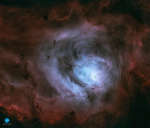 The Lagoon Nebula without Stars
8.08.2022
Ridges of glowing interstellar gas and dark dust clouds inhabit the turbulent, cosmic depths of the Lagoon Nebula. Also known as M8, the bright star forming region is about 5,000 light-years distant.
 Cosmos in Reflection
22.09.2023
During the day, over 12,000 large mirrors reflect sunlight at the 100-megawatt, molten-salt, solar thermal power plant at the western edge of the Gobi desert near Dunhuang, Gansu Province, China. Individual mirror panels turn to track the sun like sunflowers.
 APOD: 2025 December 9 Б The Heart of the Soul Nebula
9.12.2025
This cosmic close-up looks deep inside the Soul Nebula. The dark and brooding dust clouds outlined by bright ridges of glowing gas are cataloged as IC 1871. About 25 light-years across, the telescopic field of view spans only a small part of the much larger Heart and Soul nebulae.
 Galaxies in the River
11.12.2025
Large galaxies grow by eating small ones. Even our own galaxy engages in a sort of galactic cannibalism, absorbing small galaxies that are too close and are captured by the Milky Way's gravity.
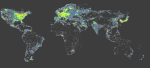 Artificial Night Sky Brightness
27.08.2001
Where have all the dim stars gone? From many places on the Earth including major cities, the night sky has been reduced from a fascinating display of hundreds of stars to a diffuse glow through which only a handful of stars are visible.
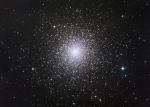 Globular Star Cluster M3
9.06.2007
This immense ball of half a million stars older than the Sun lies over 30,000 light-years away. Cataloged as M3 (and NGC 5272), it is one of about 150 globular star clusters that roam the halo of our Milky Way Galaxy.
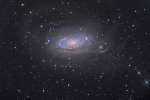 Messier 63: The Sunflower Galaxy
17.04.2008
A bright spiral galaxy of the northern sky, Messier 63 is about 25 million light-years distant in the loyal constellation Canes Venatici. Also cataloged as NGC 5055, the majestic island universe is nearly 100,000 light-years across, about the size of our own Milky Way.
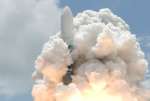 At Last, GLAST
13.06.2008
Rising through a billowing cloud of smoke, this Delta II rocket left Cape Canaveral Air Force Station's launch pad 17-B Wednesday at 12:05 pm EDT. Snug in the payload section was GLAST, the Gamma-ray Large Area Space Telescope, now in orbit around planet Earth.
|
January February March April May June July August September October |
|||||||||||||||||||||||||||||||||||||||||||||||||