
|
You entered: image
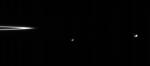 Epimetheus and Janus: Interchangeable Moons of Saturn
2.11.2005
These two moons change places. Epimetheus and Janus, two small moons of Saturn, actually switch positions as they orbit their home planet. The orbital radii of the moons are strangely separated by less than the radii of the moons themselves: about 50 kilometers. One moon orbits Saturn well ahead of the other, at first.
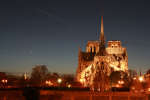 Mercury and Venus Over Paris
12.04.2010
Go outside tonight and see one of the more interesting planetary conjunctions of recent years. Just after sunset, the planets Mercury and Venus are visible quite near each other. Now Venus, being commonly discernible as one of the brightest objects in the sky, is frequently mistaken for an airplane.
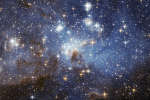 Star Forming Region LH 95
12.03.2008
How do stars form? To better understand this complex and chaotic process, astronomers used the Hubble Space Telescope to image in unprecedented detail the star forming region LH 95 in the nearby Large Magellanic Cloud galaxy.
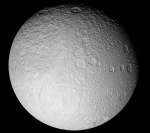 Ice Moon Tethys from Saturn Orbiting Cassini
8.12.2009
What processes formed the unusual surface of Saturn's moon Tethys? To help find out, NASA sent the robotic Cassini spacecraft right past the enigmatic ice moon in 2005. Pictured above is one of the highest resolution images of an entire face of Tethys yet created.
 APOD: 2023 May 22 Б Supernova Discovered in Nearby Spiral Galaxy M101
22.05.2023
A nearby star has exploded and humanity's telescopes are turning to monitor it. The supernova, dubbed SN 2023ifx, was discovered by Japanese astronomer Koichi Itagaki three days ago and subsequently located on automated images from the Zwicky Transient Facility two days earlier.
 Mira: The Wonderful Star
22.07.2006
To seventeenth century astronomers, Omicron Ceti or Mira was known as a wonderful star - a star whose brightness could change dramatically in the course of about 11 months. Modern astronomers now recognize an entire class of long period Mira-type variables as cool, pulsating, red giant stars, 700 or so times the diameter of the Sun.
 NGC 2392: Double Shelled Planetary Nebula
16.02.2020
To some, this huge nebula resembles a person's head surrounded by a parka hood. In 1787, astronomer William Herschel discovered this unusual planetary nebula: NGC 2392. More recently, the Hubble Space Telescope imaged the nebula in visible light, while the nebula was also imaged in X-rays by the Chandra X-ray Observatory.
 Good Morning Mars
19.06.1998
Looking down on the Northern Hemisphere of Mars on June 1, the Mars Global Surveyor spacecraft's wide angle camera recorded this morning image of the red planet. Mars Global Surveyor's orbit...
 The Great Basin on Tethys
8.02.2006
Some moons wouldn't survive the collision. Tethys, one of Saturn's larger moons at about 1000 kilometers in diameter, survived the collision, but sports today the expansive impact crater Odysseus. Sometimes called...
 Perseid Meteors and the Milky Way
14.08.2012
Where will the next Perseid meteor appear? Sky enthusiasts who trekked outside for the Perseid meteor shower that peaked over the past few days typically had this question on their mind. Six meteors from...
|
January February March April May June July August September |
|||||||||||||||||||||||||||||||||||||||||||||||||