
|
You entered: galaxy center
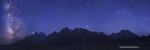 A Spectacular Sky Over the Grand Tetons
14.08.2007
Behold the breathtaking beauty of Earth and sky together. In the foreground is the Teton Mountain Range of Wyoming, USA. The Grand Tetons are a relatively isolated set of high peaks that are part of the Rocky Mountains.
 Chasing Carina
26.02.2010
A jewel of the southern sky, the Great Carina Nebula, aka NGC 3372, spans over 300 light-years. Near the upper right of this expansive skycape, it is much larger than the more northerly Orion Nebula.
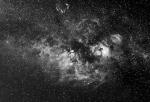 Cygnus Nebulosities
23.10.2003
Looking toward the constellation Cygnus, a stunning and complex region of nebulae strewn along the plane of our Milky Way galaxy is revealed in this unique wide-angle sky view. Recorded with a filter designed...
 The Light, the Dark, and the Dusty
10.01.2024
This colorful skyscape spans about three full moons across nebula rich starfields along the plane of our Milky Way Galaxy toward the royal northern constellation Cepheus. Near the edge of the region's massive...
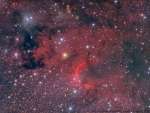 The Light, the Dark, and the Dusty
28.09.2018
This colorful skyscape spans about two full moons across nebula rich starfields along the plane of our Milky Way Galaxy in the royal northern constellation Cepheus. Near the edge of the region's massive...
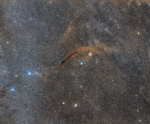 NGC 4372 and the Dark Doodad
30.03.2023
The delightful Dark Doodad Nebula drifts through southern skies, a tantalizing target for binoculars toward the small constellation Musca, The Fly. The dusty cosmic cloud is seen against rich starfields just south of the Coalsack Nebula and the Southern Cross.
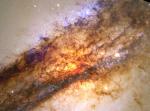 The Center of Centaurus A
17.07.2005
A fantastic jumble of young blue star clusters, gigantic glowing gas clouds, and imposing dark dust lanes surrounds the central region of the active galaxy Centaurus A. This mosaic of Hubble Space Telescope images taken in blue, green, and red light has been processed to present a natural color picture of this cosmic maelstrom.
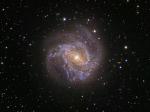 Spiral Galaxy M83: The Southern Pinwheel
24.07.2007
M83 is one of the closest and brightest spiral galaxies on the sky. Visible with binoculars in the constellation of Hydra, majestic spiral arms have prompted its nickname as the Southern Pinwheel. Although discovered...
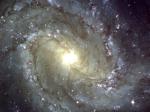 M83: The Southern Pinwheel Galaxy from VLT
18.12.2005
M83 is one of the closest and brightest spiral galaxies on the sky. Visible with binoculars in the constellation of Hydra, majestic spiral arms have prompted its nickname as the Southern Pinwheel. Although discovered...
 Will the Universe End in a Big Rip
3.03.2003
How will our universe end? Recent speculation now includes a pervasive growing field of mysterious repulsive energy that rips virtually everything apart. Although the universe started with a Big Bang, analysis of recent cosmological measurements allows a possibility that it will end with a Big Rip.
|
January February March April May June July August |
||||||||||||||||||||||||||||||||||||||||||||||||||||||||