
|
You entered: atmosphere
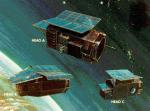 A High Energy Fleet
24.05.1998
Looking like a fleet of futuristic starcruisers, NASA's highly successful series of High Energy Astrophysical Observatory (HEAO) spacecraft appear poised over planet Earth. Labeled A, B, and C in this vintage illustration, the spacebased telescopes were known as HEAO-1, HEAO-2, and HEAO-3 respectively.
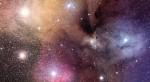 The Colorful Clouds of Rho Ophiuchi
9.07.2005
The many spectacular colors of the Rho Ophiuchi (oh'-fee-yu-kee) clouds highlight the many processes that occur there. The blue regions shine primarily by reflected light. Blue light from the star Rho Ophiuchi and nearby stars reflects more efficiently off this portion of the nebula than red light.
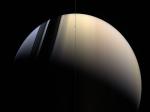 Saturn in Blue and Gold
3.05.2006
Why is Saturn partly blue? The above picture of Saturn approximates what a human would see if hovering close to the giant ringed world. The above picture was taken in mid-March by the robot Cassini spacecraft now orbiting Saturn. Here Saturn's majestic rings appear directly only as a thin vertical line.
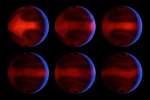 A Dangerous Summer on HD 80606b
4.02.2009
On the distant planet HD 80606b, summers might be dangerous. Hypothetic life forms floating in HD 080606b's atmosphere or lurking on one of its (presently hypothetical) moons might fear the 1,500 Kelvin summer heat, which is hot enough not only to melt lead but also nickel.
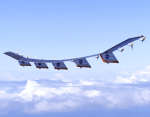 A Flight of Helios
24.07.2011
An example of solar-powered flight, NASA's Helios aircraft flew almost one hundred years after the Wright brothers' historic flight on December 17, 1903. Pictured here at 3,000 meters in in skies northwest of Kauai, Hawaii, USA in August 2001, the remotely piloted Helios is traveling at about 40 kilometers per hour.
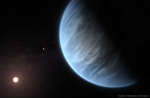 Water Vapor Discovered on Distant Exoplanet
17.09.2019
Where else might life exist? One of humanity's great outstanding questions, locating planets where extrasolar life might survive took a step forward recently with the discovery of a significant amount of water vapor in the atmosphere of distant exoplanet K2-18b.
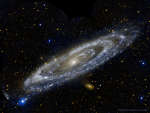 The Andromeda Galaxy in Ultraviolet
18.07.2021
What does the Andromeda galaxy look like in ultraviolet light? Young blue stars circling the galactic center dominate. A mere 2.5 million light-years away, the Andromeda Galaxy, also known as M31, really is just next door as large galaxies go.
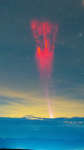 APOD: 2026 July 15 Б Red Sprites in the Tatacoa Desert
15.07.2026
Is there an angry Sith using force lightning in the Tatacoa Desert? This is not science fiction, but a red sprite with multiple streamers! Ordinary lightning occurs when thundercloud particles collide, lose their electrons, and build up negative charge at the cloud bottom.
 Melting Snow and the Gullies of Mars
21.02.2003
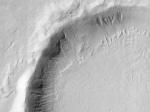
Tantalizing images of gullies on Mars have offered striking evidence for recent flows of liquid water. But Mars is too cold and its atmosphere too thin for liquid water to exist on the surface.
 Solar Shock Wave
30.04.1999
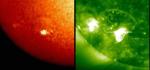
On September 24, 1997 a shock wave blasted across the surface of the sun at speeds of 250 to 600 kilometers per second. On planet Earth, observer Barry Reynolds photographed the expanding shock front (left) in the light emitted by hydrogen atoms at the solar surface.
|
January February March April May June July August September |
|||||||||||||||||||||||||||||||||||||||||||||||||