
|
You entered: Solar System
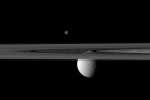 Moons Beyond the Rings of Saturn
12.07.2010
What's happened to that moon of Saturn? Nothing -- Saturn's moon Rhea is just partly hidden behind Saturn's rings. In April, the robotic Cassini spacecraft now orbiting Saturn took this narrow-angle view looking across the Solar System's most famous rings.
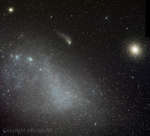 Cloud, Clusters and Comet Siding Spring
4.09.2014
On October 19th, a good place to watch Comet Siding Spring will be from Mars. Then, this inbound visitor (C/2013 A1) to the inner solar system, discovered in January 2013 by Robert McNaught at Australia's Siding Spring Observatory, will pass within 132,000 kilometers of the Red Planet.
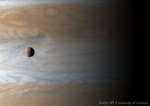 Io: Moon over Jupiter
7.08.2016
How big is Jupiter's moon Io? The most volcanic body in the Solar System, Io (usually pronounced "EYE-oh") is 3,600 kilometers in diameter, about the size of planet Earth's single large natural satellite.
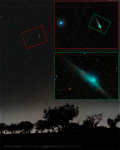 APOD: 2023 January 31 Б A Triple View of Comet ZTF
31.01.2023
Comet ZTF has a distinctive shape. The now bright comet visiting the inner Solar System has been showing not only a common dust tail, ion tail, and green gas coma, but also an uncommonly distinctive antitail.
 APOD: 2025 September 1 Б Callisto: Dirty Battered Iceball
1.09.2025
Its surface is the most densely cratered in the Solar System -- but what's inside? Jupiter's moon Callisto is a battered ball of dirty ice that is larger than the planet Mercury.
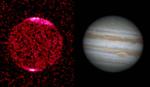 Jupiter s Great X Ray Spot
1.03.2002
The Solar System's largest planet, gas giant Jupiter, is famous for its swirling Great Red Spot. In the right hand panel above, the familiar giant planet with storm system and cloud bands is shown in an optical image from the passing Cassini spacecraft.
 In the Center of the Omega Nebula
6.05.2012
In the depths of the dark clouds of dust and molecular gas known as the Omega Nebula, stars continue to form. The above image from the Hubble Space Telescope's Advanced Camera for Surveys shows exquisite detail in the famous star-forming region.
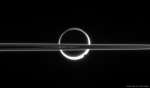 Saturn, Titan, Rings, and Haze
5.05.2019
This is not a solar eclipse. Pictured here is a busy vista of moons and rings taken at Saturn. The large circular object in the center of the image is Titan, the largest moon of Saturn and one of the most intriguing objects in the entire Solar System.
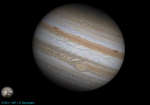 Jupiter Rotates
26.10.2021
Observe the graceful twirl of our Solar System's largest planet. Many interesting features of Jupiter's enigmatic atmosphere, including dark belts and light zones, can be followed in detail. A careful inspection will reveal that different cloud layers rotate at slightly different speeds.
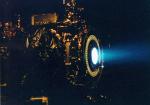 An Ion Drive for Deep Space 1
20.07.2003
Space travel entered the age of the ion drive in 1998 with the launch of Deep Space 1, a NASA mission designed primarily to test new technologies. Although the ion drive on Deep Space...
|
January February March April May June July August September |
|||||||||||||||||||||||||||||||||||||||||||||||||