
|
You entered: star
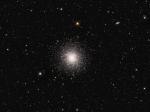 M13: The Great Globular Cluster in Hercules
18.05.2007
In 1714, Edmond Halley noted that M13 "shows itself to the naked eye when the sky is serene and the Moon absent." Of course, M13 is now modestly recognized as the Great Globular Cluster in Hercules, one of the brightest globular star clusters in the northern sky.
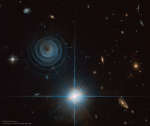 The Extraordinary Spiral in LL Pegasi
28.11.2021
What created the strange spiral structure on the upper left? No one is sure, although it is likely related to a star in a binary star system entering the planetary nebula phase, when its outer atmosphere is ejected.
 The 37 Cluster
13.05.2024
For the mostly harmless denizens of planet Earth, the brighter stars of open cluster NGC 2169 seem to form a cosmic 37. Did you expect 42? From our perspective, the improbable numerical asterism appears solely by chance. It lies at an estimated distance of 3,300 light-years toward the constellation Orion.
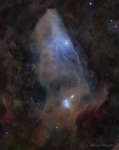 APOD: 2026 April 7 Б IC 4592: The Blue Horsehead Reflection Nebula
6.04.2026
Do you see the horse's head? What you are seeing is not the famous Horsehead nebula toward Orion, but rather a fainter nebula that only takes on a familiar form with deeper imaging. The main part of the here-imaged molecular cloud complex is reflection nebula IC 4592.
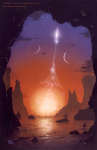 Dawn Before Nova
16.11.2009
Will this dawn bring another nova? Such dilemmas might be pondered one day by future humans living on a planet orbiting a cataclysmic variable binary star system. Cataclysmic variables involve gas falling from a large star onto an accretion disk surrounding a massive but compact white dwarf star.
 Southern Cross in Mauna Loa Skies
28.01.2005
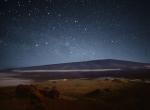
Gazing across this gorgeous skyscape, the Southern Cross and stars of the constellation Centaurus are seen above the outline of Mauna Loa (Long Mountain), planet Earth's largest volcano. Unfamiliar to sky gazers north...
 APOD: 2025 April 28 Б Gum 37 and the Southern Tadpoles
27.04.2025
This cosmic skyscape features glowing gas and dark dust clouds alongside the young stars of NGC 3572. A beautiful emission nebula and star cluster, it sails far southern skies within the nautical constellation Carina.
 NGC 7009: The Saturn Nebula
29.12.1997
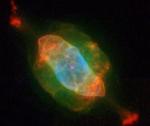
The layers of the Saturn Nebula give a complex picture of how this planetary nebula was created. The above picture, taken in April 1996 and released last week, allows a better understanding of the mysterious process that transformed a low-mass star into a white dwarf star.
 Kemble s Cascade
27.01.2010
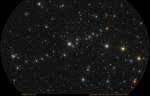
An asterism is just a recognized pattern of stars that is not one the 88 official constellations. For example, one of the most famous (and largest) asterisms is the Big Dipper within the constellation Ursa Major.
 The Antennae Galaxies in Collision
18.07.2010
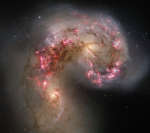
Two galaxies are squaring off in Corvus and here are the latest pictures. But when two galaxies collide, the stars that compose them usually do not. That's because galaxies are mostly empty space and, however bright, stars only take up only a small amount of that space.
|
January February March April May June July August September |
|||||||||||||||||||||||||||||||||||||||||||||||||