
|
You entered: magnetic field
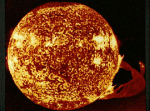 The Sun Erupts
30.08.1998
The Sun is a seething ball of extremely hot gas. Above, the Sun was captured by Skylab in 1973 throwing off one the largest eruptive prominences in recorded history. The Sun has survived for about 5 billion years, and will likely survive for another 5 billion.
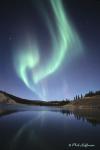 Dueling Auroras
3.12.2001
Will it be curtains for one of these auroras? A quick inspection indicates that it is curtains for both, as the designation "curtains" well categorizes the type of aurora pattern pictured. Another (informal) type is the corona. The above auroras resulted from outbursts of ionic particles from the Sun during the last week of September.
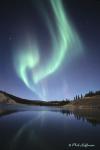 Dueling Auroras
7.08.2005
Will it be curtains for one of these auroras? A quick inspection indicates that it is curtains for both, as the designation "curtains" well categorizes the type of aurora pattern pictured. Another (informal) type is the corona.
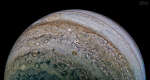 Complex Jupiter
5.06.2018
How complex is Jupiter? NASA's Juno mission to Jupiter is finding the Jovian giant to be more complicated than expected. Jupiter's magnetic field has been discovered to be much different from our Earth's simple dipole field, showing several poles embedded in a complicated network more convoluted in the north than the south.
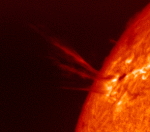 A Solar Corona Ejection
8.11.1996
The Sun would not be a nice place to spend the summer. One reason, besides the extreme heat, is that explosions are common there. In the above picture, magnetic fields buckle releasing previously constrained hot material from the upper atmosphere of the Sun.
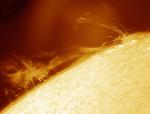 At the Edge of the Sun
7.07.2003
Dramatic prominences can sometimes be seen looming just beyond the edge of the sun. A solar prominence is a cloud of solar gas held just above the surface by the Sun's magnetic field. The Earth would easily fit below the prominence on the left.
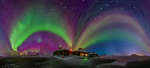 Lapland Northern Lights
8.04.2016
Early spring in the northern hemisphere is good season for aurora hunters. Near an equinox Earth's magnetic field is oriented to favor interactions with the solar wind that trigger the alluring glow of the northern lights. On March 28/29 the skies over Kaunispää Hill, Lapland, Finland did not disappoint.
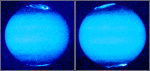 Jupiter's Auroras
18.10.1996
Auroras are especially large on Jupiter. In pictures released yesterday, the Hubble Space Telescope imaged these unusual light displays in more detail than ever before. Jupiter's auroras are linked to its volcanic moon Io.
 An Active Prominence on the Sun
18.06.2018
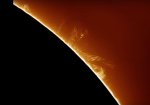
Sometimes the Sun's surface becomes a whirlwind of activity. Pictured is a time-lapse video of the Sun's surface taken over a two hour period in early May, run both forwards and backwards. The Sun's surface was blocked out so that details over the edge could be imaged in greater detail.
 A Yukon Aurora
8.10.2001
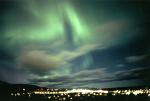
Last week was another good week for auroras. The story began about two weeks ago when two large Coronal Mass Ejections exploded off the Sun. Waves of elementary particles and ions swept out past the Earth on September 28 and 29, causing many auroras.
|
January February March April May June July August September October |
|||||||||||||||||||||||||||||||||||||||||||||||||