
|
You entered: galactic plane
 Clouds of Perseus
21.10.2011
Cosmic clouds of gas and dust drift across this magnificent panorama, spanning some 17 degrees near the southern boundary of the heroic constellation Perseus. The collaborative skyscape begins with bluish stars of Perseus at the left, but the eye is drawn to the striking, red NGC 1499.
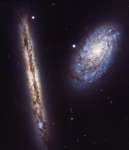 NGC 4302 and NGC 4298
21.04.2017
Seen edge-on, spiral galaxy NGC 4302 (left) lies about 55 million light-years away in the well-groomed constellation Coma Berenices. A member of the large Virgo Galaxy Cluster, it spans some 87,000 light-years, a little smaller than our own Milky Way.
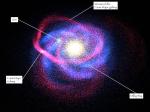 The Closest Galaxy: Canis Major Dwarf
4.11.2007
What is the closest galaxy to the Milky Way? The new answer to this old question is the Canis Major dwarf galaxy. For many years astronomers thought the Large Magellan Cloud (LMC) was closest, but its title was supplanted in 1994 by the Sagittarius dwarf galaxy.
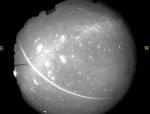 A 2001 Leonids Meteor Shower Fireball
19.11.2001
The 2001 Leonids Meteor Shower gave quite a show to many parts of the world yesterday during the early morning hours. Many sleepy observers venturing into their own backyards were treated to several bright meteors per minute streaking across the sky.
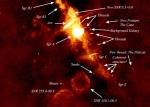 The Galactic Center A Radio Mystery
3.08.2002
Tuning in to the center of our Milky Way galaxy, radio astronomers explore a complex, mysterious place. A premier high resolution view, this startlingly beautiful picture covers a 4x4 degree region around the galactic center.
 IFN and the NGC 7771 Group
31.08.2024
Galaxies of the NGC 7771 Group are featured in this intriguing skyscape. Some 200 million light-years distant toward the constellation Pegasus, NGC 7771 is the large, edge-on spiral near center, about 75,000 light-years across, with two smaller galaxies below it. Large spiral NGC 7769 is seen face-on to the right.
 APOD: 2025 July 14 Б NGC 2685: The Helix Galaxy
14.07.2025
What is going on with this galaxy? NGC 2685 is a confirmed polar ring galaxy - a rare type of galaxy with stars, gas and dust orbiting in rings perpendicular to the plane of a flat galactic disk.
 Galaxies, Stars, and Dust
13.10.2012
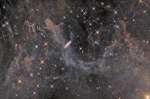
Spiky stars and spooky shapes abound in this deep cosmic skyscape. Its well-composed field of view covers about 2 Full Moons on the sky toward the constellation Pegasus. Of course the brighter stars show diffraction spikes, the commonly seen effect of internal supports in reflecting telescopes, and lie well within our own Milky Way galaxy.
 Clouds of Andromeda
4.01.2017
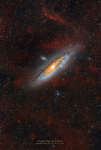
The beautiful Andromeda Galaxy is often imaged by planet Earth-based astronomers. Also known as M31, the nearest large spiral galaxy is a familiar sight with dark dust lanes, bright yellowish core, and spiral arms traced by blue starlight.
 Edge On Galaxy NGC 5866
9.03.2016
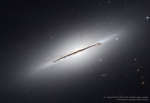
Why is this galaxy so thin? Many disk galaxies are actually just as thin as NGC 5866, pictured above, but are not seen edge-on from our vantage point. One galaxy that is situated edge-on is our own Milky Way Galaxy.
|
January February March April May June July August |
||||||||||||||||||||||||||||||||||||||||||||||||||||||||