
|
You entered: background
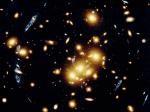 Giant Cluster Bends, Breaks Images
7.08.2004
What are those strange blue objects? Many are images of a single, unusual, beaded, blue, ring-like galaxy which just happens to line-up behind a giant cluster of galaxies. Cluster galaxies here appear yellow and -- together with the cluster's dark matter -- act as a gravitational lens.
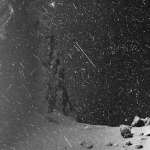 The Snows of Churyumov Gerasimenko
15.03.2020
You couldn't really be caught in this blizzard while standing by a cliff on Churyumov-Gerasimenko. Orbiting the comet -- frequently abbreviated as 67P or CG -- in June of 2016, the Rosetta spacecraft's narrow...
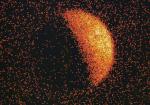 X Ray Moon
2.09.2000
This x-ray image of the Moon was made by the orbiting ROSAT (Röntgensatellit) Observatory in 1990. In this digital picture, pixel brightness corresponds to x-ray intensity. Consider the image in three parts: the bright hemisphere of the x-ray moon, the darker half of the moon, and the x-ray sky background.
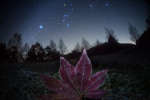 Frosted Leaf Orion
17.11.2010
Sometimes, you can put some night sky in your art. Captured above Japan earlier this month, a picturesque night sky was photographed behind a picturesque frosted leaf. The reflecting ice crystals on the leaf coolly mimic the shining stars far in the background.
 A MACHO View of Galactic Dark Matter
2.02.1996
What is our Galaxy made of? Stellar motions indicate there is much more mass than just stars and gas. Photographs like the two shown above may be yielding a clue about the dark matter, however.
 The Snows of Churyumov Gerasimenko
6.01.2024
You couldn't really be caught in this blizzard while standing by a cliff on periodic comet 67P/Churyumov-Gerasimenko. Orbiting the comet in June of 2016, the Rosetta spacecraft's narrow angle camera did record...
 APOD: 2025 January 27 Б Pleiades over Half Dome
27.01.2025
Stars come in bunches. The most famous bunch of stars on the sky is the Pleiades, a bright cluster that can be easily seen with the unaided eye. The Pleiades lies only about 450 light years away, formed about 100 million years ago, and will likely last about another 250 million years.
 Abell 1689 Warps Space
9.01.2003
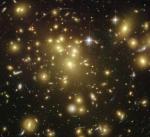
Two billion light-years away, galaxy cluster Abell 1689 is one of the most massive objects in the Universe. In this view from the Hubble Space Telescope's Advanced Camera for Surveys, Abell...
 The Observable Universe
8.05.2018
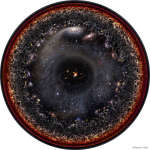
How far can you see? Everything you can see, and everything you could possibly see, right now, assuming your eyes could detect all types of radiations around you -- is the observable universe. In visible...
 APOD: 2023 July 18 Б Milky Way above La Palma Observatory
18.07.2023
What's happening in the night sky? To help find out, telescopes all over the globe will be pointing into deep space. Investigations will include trying to understand the early universe, finding and tracking Earth-menacing asteroids, searching for planets that might contain extra-terrestrial life, and monitoring stars to help better understand our Sun.
|
January February March April May June July August |
||||||||||||||||||||||||||||||||||||||||||||||||||||||||