
|
You entered: Voyager 2
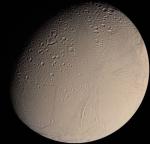 Ski Enceladus
24.01.2002
A small inner moon of Saturn, Enceladus is only about 500 kilometers in diameter. But the cold, distant world does reflect over 90 percent of the sunlight it receives, giving its surface about the same reflectivity as new-fallen snow.
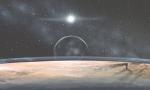 Pluto: New Horizons
18.10.2001
Pluto's horizon spans the foreground in this artist's vision, gazing sunward across that distant and still unexplored world. Titled New Horizons, the painting also depicts Pluto's companion, Charon, as a darkened, ghostly apparition with a luminous crescent against a starry background.
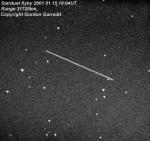 Sail On Stardust
25.01.2001
Spacecraft on long interplanetary voyages often use the planets themselves as gravitational "sling shots" to boost them along their way. Launched in February of 1999 on a historic voyage to a comet, the Stardust spacecraft is no different.
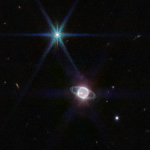 Ringed Ice Giant Neptune
23.09.2022
Ringed, ice giant Neptune lies near the center of this sharp near-infrared image from the James Webb Space Telescope. The dim and distant world is the farthest planet from the Sun, about 30 times farther away than planet Earth.
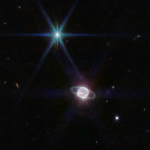 Ringed Ice Giant Neptune
19.08.2023
Ringed ice giant Neptune lies near the center of this sharp near-infrared image from the James Webb Space Telescope. The dim and distant world is the farthest planet from the Sun, about 30 times farther away than planet Earth.
 Ringed Ice Giant Neptune
6.09.2024
Ringed ice giant Neptune lies near the center of this sharp near-infrared image from the James Webb Space Telescope. The dim and distant world is the farthest planet from the Sun, about 30 times farther away than planet Earth.
 Hubble s Jupiter and Shrinking Great Red Spot
17.05.2014
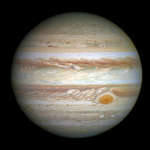
Gas giant Jupiter is the solar system's largest world with about 320 times the mass of planet Earth. It's also known for a giant swirling storm system, the Great Red Spot, featured in this sharp Hubble image from April 21.
 Ringed Planet Uranus
15.01.2003
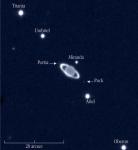
Yes it does look like Saturn, but Saturn is one of only four giant ringed planets in our Solar System. And while Saturn has the brightest rings, this system of rings and moons actually belongs to planet Uranus, imaged here in near-infrared light by the Antu telescope at the ESO Parnal Observatory in Chile.
 Voyager's Preview of Galileo at Ganymede
27.06.1996
NASA's robot spacecraft Galileo began its long voyage to Jupiter in October of 1989. In December of last year it arrived in the Jovian system, beginning its unprecedented, detailed exploration by dropping a probe into the gas giant's atmosphere. By early this morning it will have accomplished another milestone in its ambitious mission.
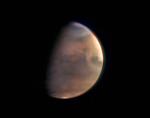 Express to Mars
18.12.2003
Hurtling toward its destination, the high resolution camera on board ESA's Mars Express spacecraft recorded this tantalizing view of the Red Planet earlier this month on December 3rd. Seen from a distance of 5.5 million kilometers, features across part of Mars' western hemisphere are bathed in sunlight.
|
January February March April May June July August September |
|||||||||||||||||||||||||||||||||||||||||||||||||