
|
You entered: Jupiter's Moons
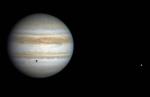 Cassini Spacecraft Approaches Jupiter
11.10.2000
A new spacecraft has entered the outer Solar System: Cassini. Launched in 1997 and bound for Saturn in 2004, Cassini sent back the above image last week while approaching the giant planet Jupiter. Cassini joins the Galileo spacecraft currently in orbit around Jupiter in studying the gas giant and its moons.
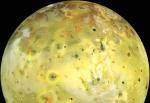 Io in True Color
15.07.2001
The strangest moon in the Solar System is bright yellow. This picture, showing Io's true colors, was taken in 1999 July by the Galileo spacecraft currently orbiting Jupiter. Io's colors derive from sulfur and molten silicate rock. The unusual surface of Io is kept very young by its system of active volcanoes.
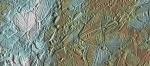 Europa's Disconnected Surface
1.01.1998
Jupiter's moon Europa is so exciting that the Galileo spacecraft orbiting Jupiter has now embarked on an extended mission to study it. Oceans that might exist beneath Europa's surface are thought to be one of the best places to look for life in our Solar System.
 Crater On Ice
14.07.2000
Impact craters are common on Earth's moon but on Jupiter's large ice moon Europa, they are very rare. Over time, both bodies have been subjected to an intense pounding by the solar system's formative debris, but geological activity on Europa's surface seems to have erased most of these impact scars.
 Io in True Color
2.05.2004
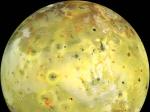
The strangest moon in the Solar System is bright yellow. This picture, showing Io's true colors, was taken in 1999 July by the Galileo spacecraft that orbited Jupiter from 1995 to 2003. Io's colors derive from sulfur and molten silicate rock.
 Io in True Color
20.09.1999
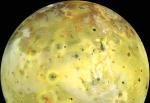
The strangest moon in the Solar System is bright yellow. This recently released picture, showing Io's true colors, was taken in July by the Galileo spacecraft currently orbiting Jupiter. Io's colors derive from sulfur and molten silicate rock. The unusual surface of Io is kept very young by its system of active volcanoes.
 Europa's Ice Rafts
10.04.1997
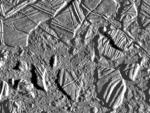
The surface of Jupiter's moon Europa has shifted. Photographs released yesterday of Europa's surface taken by the spacecraft Galileo show that the smooth moon's icy surface is sometimes like a giant scrambled jigsaw puzzle. Pieces of Europa's surface, identifiable above, have rafted to new locations.
 Juno Flyby of Ganymede and Jupiter
10.10.2021
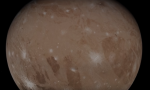
What would it be like to fly over the largest moon in the Solar System? In June, the robotic Juno spacecraft flew past Jupiter's huge moon Ganymede and took images that have been digitally constructed into a detailed flyby.
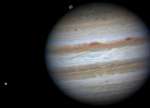 Jupiter Near Opposition
22.10.2011
On October 29 (UT), Jupiter, the solar system's largest planet, will be at opposition, opposite the Sun in planet Earth's sky, shining brightly and rising as the Sun sets. That configuration results...
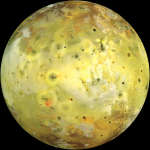 Io in True Color
3.10.2010
The strangest moon in the Solar System is bright yellow. This picture, an attempt to show how Io would appear in the "true colors" perceptible to the average human eye, was taken in 1999 July by the Galileo spacecraft that orbited Jupiter from 1995 to 2003.
|
January February March April May June July August September |
|||||||||||||||||||||||||||||||||||||||||||||||||