
|
Keyword: interstellar medium
 The Solar Neighborhood
25.02.1998
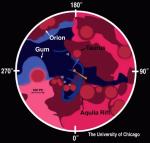
You are here. The orange dot in the above false-color drawing represents the current location of the Sun among local gas clouds in the spiral Milky Way Galaxy. These gas clouds are so thin that we usually see right through them. Nearly spherical bubbles surround regions of recent star formation.
 Fractal Interstellar Dust Up Close
4.01.1998
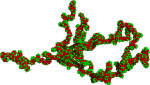
Our universe is a very dusty place. Dust usually shows its presence by blocking out light emitted from stars or nebulae behind it, sometimes creating the illusion of a horse's head or a sombrero hat. But nobody really knows what a typical interstellar dust grain looks like.
 Fractal Interstellar Dust Up Close
9.05.1999
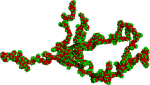
Our universe is a very dusty place. Dust usually shows its presence by blocking out light emitted from stars or nebulae behind it, sometimes creating the illusion of a horse's head or a sombrero hat. But nobody really knows what a typical interstellar dust grain looks like. By
 Billows of Smog in the Outer Galaxy
15.01.2001
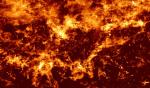
Our Galaxy is filled with gas. Most of this gas is hydrogen, some is helium, but there is a trace amount of relatively heavy molecules, including carbon monoxide (CO) - a component of smog. The above wide-angle radio CO image shows the incredibly diverse structures that the molecular interstellar medium forms.
 A Sky Full Of Hydrogen
1.03.1998
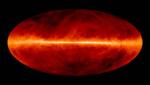
Interstellar space is filled with extremely tenuous clouds of gas which are mostly Hydrogen. The neutral hydrogen atom (HI in astronomer's shorthand) consists of 1 proton and 1 electron. The proton and electron spin like tops but can have only two orientations; spin axes parallel or anti-parallel.
 A Sky Full Of Hydrogen
13.01.2001
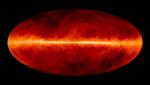
Interstellar space is filled with extremely tenuous clouds of gas which are mostly Hydrogen. The neutral hydrogen atom (HI in astronomer's shorthand) consists of 1 proton and 1 electron. The proton and electron spin like tops but can have only two orientations; spin axes parallel or anti-parallel.
|
January February March April May June July August September |
|||||||||||||||||||||||||||||||||||||||||||||||||