
|
Keyword: satellite
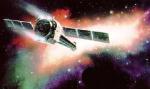 Name This Satellite
20.04.1998
Can you name this satellite? In December, NASA's third Great Observatory is planned for launch. The two NASA Great Observatories currently in orbit are the Hubble Space Telescope and the Compton Gamma-Ray Observatory, both now named for famous scientists. But after whom should the Advanced X-ray Astrophysics Facility (AXAF) be named?
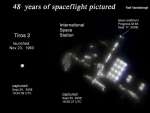 48 Years of Space Flight
16.10.2008
This year, NASA celebrated its 50th anniversary. Inspired to make his own contribution, astronomer Ralf Vandebergh set out to record images of some historic spacecraft in Earth orbit -- captured with his own modest equipment and a hand-guided, 10-inch, Newtonian reflecting telescope. One result is this intriguing composite effectively spanning 48 years of space flight!
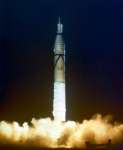 The First Explorer
1.02.2008
Fifty years ago (on January 31, 1958) the First Explorer, was launched into Earth orbit by the Army Ballistic Missile Agency. Inaugurating the era of space exploration for the United States, Explorer I was a thirty pound satellite that carried instruments to measure temperatures, and micrometeorite impacts, along with an experiment designed by James A.
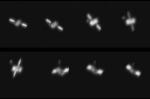 Compton Returns
7.03.2001
On 2000 June 4, the 17-ton Compton Gamma-Ray Observatory returned to Earth after 9 years in orbit -- ending its remarkable voyage of discovery. The massive, bus-sized spacecraft carried an unprecedented array of gamma-ray detectors which explored the bizarre, high-energy universe of solar flares, black holes, pulsars, supernovae, active galaxies, and gamma-ray bursts.
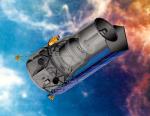 SIRTF: Name This Satellite
19.09.2001
NASA is preparing to launch its next Great Observatory in 2002, but it does not yet have a proper name. Can you help? Currently referred to only as the Space Infrared Telescope Facility (SIRTF), NASA seeks to add something more significant.
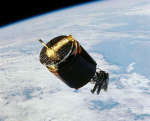 The Astronaut Who Captured a Satellite
11.01.2010
In 1984, high above the Earth's surface, an astronaut captured a satellite. It was the second satellite captured that mission. Pictured above, astronaut Dale A. Gardner flies free using the Manned Maneuvering Unit and begins to attach a control device dubbed the Stinger to the rotating Westar 6 satellite.
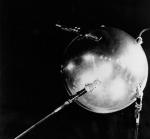 Sputnik: Traveling Companion
3.10.1998
Sputnik means "traveling companion". Despite the innocuous sounding name, the launch of the Earth's first "artificial moon", Sputnik 1, by the Soviets on October 4, 1957 shocked the free world, setting in motion events which resulted in the creation of NASA and the race to the Moon.
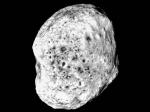 Hyperion: Sponge Moon of Saturn
26.07.2005
Why is Saturn's moon Hyperion textured like a sponge? Recent high-resolution images from the robot Cassini spacecraft orbiting Saturn show Hyperion to be an even stranger place than thought before. Previously, it was known that the length of a day on Hyperion is unpredictable.
 Epimetheus: A Small Moon of Saturn
24.08.2005
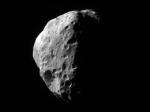
How did Epimetheus form? No one is yet sure. To help answer that question, this small moon has recently been imaged again in great detail by the robot spacecraft Cassini now orbiting Saturn. Epimetheus sometimes orbits Saturn in front of Janus, another small satellite, but sometimes behind.
 The First Explorer
12.08.2006
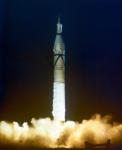
Inaugurating the era of space exploration for the US, the First Explorer, a thirty pound satellite, was launched into Earth orbit on February 1, 1958 by the Army Ballistic Missle Agency. Explorer I carried instruments to measure temperatures, micrometeorite impacts, and an experiment designed by James A.
|
January February March April May June July August September |
|||||||||||||||||||||||||||||||||||||||||||||||||