
|
Keyword: satellite
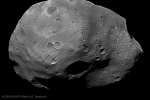 Phobos South Pole from Mars Express
24.01.2011
Where on this moon would you land? The moon pictured above is not Earth's moon but Phobos, the closest moon to the planet Mars. Phobos is so close to Mars that it is expected to break up and crash into the red planet within the next 100 million years.
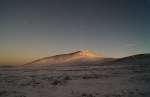 The Snows of Paranal
11.08.2011
Recorded last week, this dawn portrait of snowy mountain and starry sky captures a very rare scenario. The view does feature a pristine sky above the 2,600 meter high mountain Cerro Paranal, but clear skies over Paranal are not at all unusual.
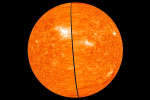 Sun 360: STEREO Captures Views of the Entire Sun
7.02.2011
For the first time, the entire Sun is being imaged all at once. This has become possible because the two STEREO satellites orbiting and monitoring the Sun are now on opposite sides of the Sun.
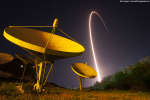 Atlas V Launches TDRS-K
1.02.2013
Beyond a fertile field of satellite communication antennas at Kennedy Space Center, an Atlas V rocket streaks into orbit in this long exposure photograph. In the thoughtfully composed image recorded on the evening...
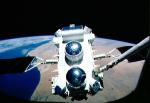 The Compton Gamma Ray Observatory
16.01.2000
The Compton Gamma Ray Observatory (CGRO) was the most massive instrument ever launched by a NASA Space Shuttle in 1991 and continues to revolutionize gamma-ray astronomy. Before Compton loses more stabilizing gyroscopes, NASA is considering firing onboard rockets to bring it on a controlled reentry into the ocean.
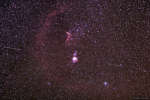 Geostationary Highway
20.02.2010
Put a satellite in a circular orbit about 42,000 kilometers from the center of the Earth (36,000 kilometers or so above the surface) and it will orbit once in 24 hours. Because that matches Earth's rotation period, it is known as a geosynchronous orbit.
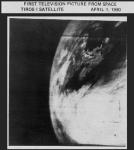 Planet Earth From TIROS 1: First TV Image
1.04.2000
The Television InfraRed Observational Satellite (TIROS) 1 was the first weather satellite. Launched into a polar orbit 40 years ago (April 1, 1960) equipped with two TV cameras, TIROS 1 was operational for only 78 days but demonstrated the feasibility of monitoring planet Earth's cloud cover and weather patterns from space.
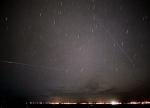 Mir Flares Farewell
23.03.2001
Streaking low across the western horizon after sunset, the Russian Mir space station makes a final pass through the evening sky above the coastal city of Salvador, Brazil. In this 5 minute 20 second time exposure made with ASA 800 film and a wide-angle lens on March 19, setting stars leave short, almost vertical trails.
 Satellites Collide in Low Earth Orbit
18.02.2009
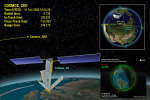
How often do satellites collide? Although minuscule space debris may strike any satellite on occasion, the first known collision between time two full satellites occurred only last week. Even though thousands of satellites have been launched, the low collision rate is caused by the great vastness of space.
 A High Energy Fleet
24.05.1998
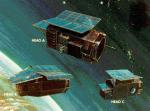
Looking like a fleet of futuristic starcruisers, NASA's highly successful series of High Energy Astrophysical Observatory (HEAO) spacecraft appear poised over planet Earth. Labeled A, B, and C in this vintage illustration, the spacebased telescopes were known as HEAO-1, HEAO-2, and HEAO-3 respectively.
|
January February March April May June July August September |
|||||||||||||||||||||||||||||||||||||||||||||||||