
|
Keyword: pulsar
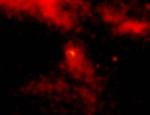 Pulsar Wind in the Vela Nebula
19.07.2001
The Vela pulsar was born 10,000 years ago at the center of a supernova -- an exploding star. In this Chandra Observatory x-ray image, the pulsar still produces a glowing nebula at the heart of the expanding cloud of stellar debris.
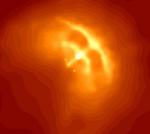 Vela Pulsar: Neutron Star-Ring-Jet
9.06.2000
This stunning image from the orbiting Chandra X-ray Observatory is centered on the Vela pulsar -- the collapsed stellar core within the Vela supernova remnant some 800 light-years distant. The Vela pulsar is a neutron star. More massive than the Sun, it has the
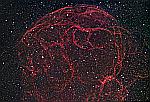 Simeis 147: Supernova Remnant
24.03.2005
It's easy to get lost following the intricate filaments in this detailed image of faint supernova remnant Simeis 147. Seen towards the constellation Taurus it covers nearly 3 degrees (6 full moons) on the sky corresponding to a width of 150 light-years at the stellar debris cloud's estimated distance of 3,000 light-years.
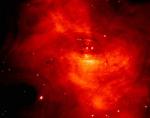 The Pulsar Powered Crab
2.06.2001
In the Summer of 1054 A.D. Chinese astronomers reported that a star in the constellation of Taurus suddenly became as bright as the full Moon. Fading slowly, it remained visible for over a year.
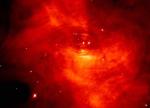 The Pulsar Powered Crab
5.09.1998
In the Summer of 1054 A.D. Chinese astronomers reported that a star in the constellation of Taurus suddenly became as bright as the full Moon. Fading slowly, it remained visible for over a year.
 The High Energy Crab Nebula
22.11.1998
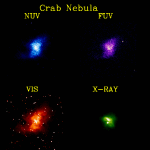
This is the mess that is left when a star explodes. The Crab Nebula is so energetic that it glows in every kind of light known. Shown above are images of the Crab Nebula from visible light to the X-ray band.
 Runaway Star
27.11.1999
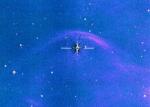
Runaway stars are massive stars traveling rapidly through interstellar space. Like a ship plowing through the interstellar medium, runaway star HD 77581 has produced this graceful arcing bow wave or "bow shock" - compressing the gaseous material in its path.
 X Ray Stars of 47 Tucanae
24.05.2001
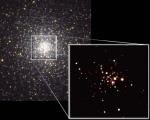
A deep optical image (left) of 47 Tucanae shows an ancient globular star cluster so dense and crowded that individual stars can not be distinguished in its closely packed core. An x-ray image of its central regions (inset right) from the Chandra Observatory reveals a wealth of x-ray stars hidden there.
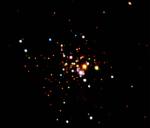 X Ray Stars of 47 Tuc
21.07.2005
Visible light images show the central region of globular cluster 47 Tucanae is closely packed, with stars less than a tenth of a light-year apart. This Chandra false-color x-ray view of central...
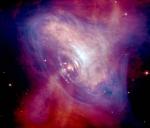 Composite Crab
26.03.2005
(xxxre linkxxx) The Crab Pulsar, a city-sized, magnetized neutron star spinning 30 times a second, lies at the center of this composite image of the inner region of the well-known Crab Nebula. The spectacular...
|
January February March April May June July August September |
|||||||||||||||||||||||||||||||||||||||||||||||||