
|
Keyword: meteor shower
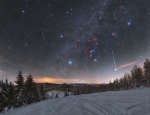 Quadrantid Meteors through Orion
19.01.2020
Why are these meteor trails nearly parallel? Because they were all shed by the same space rock and so can be traced back to the same direction on the sky: the radiant of the Quadrantid Meteor Shower.
 Geminds of the South
15.12.2021
Fireflies flash along a moonlit countryside in this scene taken on the night of December 13/14 from southern Uruguay, planet Earth. On that night meteors fell in the partly cloudy skies above during the annual Geminid meteor shower.
 Geminids in 2007
2.01.2008
Dust from curious near-Earth asteroid 3200 Phaethon seems to fall from the constellation Gemini in this fisheye skyview. The composite image was recorded over four December nights (12-15) just last year from Ludanyhalaszi, Hungary. Of course, the streaks are meteor trails from the annual Geminids meteor shower.
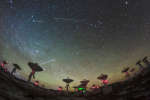 Quadrantids of the North
7.01.2022
Named for a forgotten constellation, the Quadrantid Meteor Shower puts on an annual show for planet Earth's northern hemisphere skygazers. The shower's radiant on the sky lies within the old, astronomically obsolete constellation Quadrans Muralis.
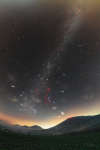 Seven Years of Halley Dust
27.10.2022
History's first known periodic comet Halley (1P/Halley) returns to the inner Solar System every 75 years or so. The famous comet made its last appearance to the naked-eye in 1986. But dusty debris...
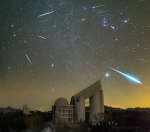 Geminid Meteors over Xinglong Observatory
12.12.2020
Where do Geminid meteors come from? In terms of location on the sky, as the featured image composite beautifully demonstrates, the sand-sized bits of rock that create the streaks of the Geminids meteor shower appear to flow out from the constellation of Gemini.
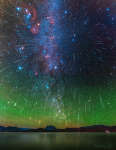 Geminids from Gemini
15.11.2021
Where are all of these meteors coming from? In terms of direction on the sky, the pointed answer is the constellation of Gemini. That is why the major meteor shower in December is known as the Geminids -- because shower meteors all appear to come from a radiant toward Gemini.
 APOD: 2025 December 15 Б Gemini Meteors over Snow Capped Mountains
14.12.2025
Where are all of these meteors coming from? In terms of direction on the sky, the pointed answer is the constellation of Gemini. That is why the major meteor shower in December is known as the Geminids -- because shower meteors all appear to come from a radiant toward Gemini.
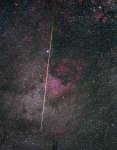 Lyrid Meteor Streak
22.04.2020
Earth's annual Lyrid Meteor Shower peaked before dawn yesterday, as our fair planet plowed through debris from the tail of long-period comet Thatcher. In crisp, clear and moonless predawn skies over Brown County...
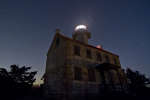 Lighthouse and Meteor
8.01.2012
Named for a forgotten constellation, the Quadrantid Meteor Shower is an annual event for planet Earth's northern hemisphere skygazers. It usually peaks briefly in the cold, early morning hours of January 4. The shower's radiant point on the sky lies within the old, astronomically obsolete constellation Quadrans Muralis.
|
January February March April May June July August September |
|||||||||||||||||||||||||||||||||||||||||||||||||