
|
Keyword: molecular cloud
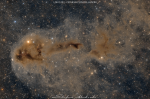 Lynds Dark Nebula 1251
24.11.2022
Stars are forming in Lynds Dark Nebula (LDN) 1251. About 1,000 light-years away and drifting above the plane of our Milky Way galaxy, the dusty molecular cloud is part of a complex of dark nebulae mapped toward the Cepheus flare region.
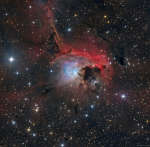 NGC 2626 along the Vela Molecular Ridge
4.02.2023
Centered in this colorful cosmic canvas, NGC 2626 is a beautiful, bright, blue reflection nebula in the southern Milky Way. Next to an obscuring dust cloud and surrounded by reddish hydrogen emission from large H II region RCW 27 it lies within a complex of dusty molecular clouds known as the Vela Molecular Ridge.
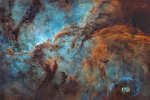 APOD: 2026 July 7 Б NGC 6188: Dragons of Ara
7.07.2026
Where can you find dragons fighting in the night sky? In the southern constellation of the Altar: Ara. The dragons are, of course, actually made of suggestively shaped gas and dust. The celestial home...
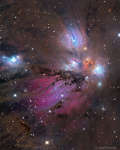 APOD: 2026 May 19 Б NGC 2170: The Angel Nebula
19.05.2026
Is this a painting or a photograph? In this celestial abstract art composed with a cosmic brush, dusty nebula NGC 2170, also known as the Angel Nebula, shines just above the image center. Reflecting...
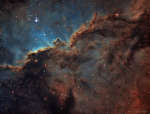 APOD: 2020 July 28 Б NGC 6188: The Dragons of Ara
28.07.2020
Dark shapes with bright edges winging their way through dusty NGC 6188 are tens of light-years long. The emission nebula is found near the edge of an otherwise dark and large molecular cloud in the southern constellation Ara, about 4,000 light-years away.
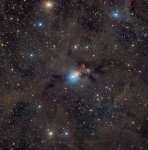 Stardust in the Perseus Molecular Cloud
18.03.2021
Clouds of stardust drift through this deep skyscape, across the Perseus molecular cloud some 850 light-years away. Dusty nebulae reflecting light from embedded young stars stand out in the nearly 2 degree wide telescopic field of view.
 Stardust in the Perseus Molecular Cloud
25.01.2025
Clouds of stardust drift through this deep skyscape, across the Perseus molecular cloud some 850 light-years away. Dusty nebulae reflecting light from embedded young stars stand out in the nearly 4 degree wide field of view. With a characteristic bluish color reflection nebula NGC 1333 is prominent near center.
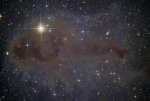 Lynds Dark Nebula
20.09.2021
Stars are forming in Lynds Dark Nebula (LDN) 1251. About 1,000 light-years away and drifting above the plane of our Milky Way galaxy, the dusty molecular cloud is part of a complex of dark nebulae mapped toward the Cepheus flare region.
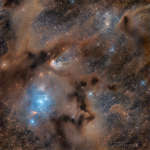 Chamaeleon I Molecular Cloud
17.02.2022
Dark markings and bright nebulae in this telescopic southern sky view are telltale signs of young stars and active star formation. They lie a mere 650 light-years away, at the boundary of the local bubble and the Chamaeleon molecular cloud complex.
 APOD: 2025 July 10 Б Lynds Dark Nebula 1251
10.07.2025
Stars are forming in Lynds Dark Nebula (LDN) 1251. About 1,000 light-years away and drifting above the plane of our Milky Way galaxy, LDN 1251 is also less appetizingly known as "The Rotten Fish Nebula." The dusty molecular cloud is part of a complex of dark nebulae mapped toward the Cepheus flare region.
|
January February March April May June July August September October |
|||||||||||||||||||||||||||||||||||||||||||||||||