
|
Keyword: molecular cloud
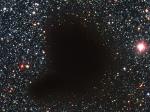 Molecular Cloud Barnard 68
9.04.2006
Where did all the stars go? What used to be considered a hole in the sky is now known to astronomers as a dark molecular cloud. Here, a high concentration of dust and molecular gas absorb practically all the visible light emitted from background stars.
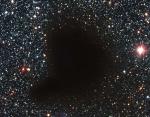 Molecular Cloud Barnard 68
2.02.2003
Where did all the stars go? What used to be considered a hole in the sky is now known to astronomers as a dark molecular cloud. Here, a high concentration of dust and molecular gas absorb practically all the visible light emitted from background stars.
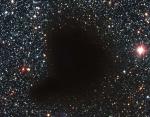 Molecular Cloud Barnard 68
19.12.2004
Where did all the stars go? What used to be considered a hole in the sky is now known to astronomers as a dark molecular cloud. Here, a high concentration of dust and molecular gas absorb practically all the visible light emitted from background stars.
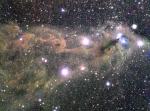
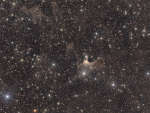 Haunting the Cepheus Flare
30.10.2008
Spooky shapes seem to haunt this starry expanse, drifting through the night in the royal constellation Cepheus. Of course, the shapes are cosmic dust clouds faintly visible in dimly reflected starlight. Far from your...
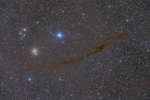
 Star Clouds Toward the Southern Crown
2.10.2002
The flowing trails of dust toward Corona Australis, the constellation of the Southern Crown, are visible here because not because they glow, but because they absorb and reflect. The dust appears bluer when seen near bright stars because it preferentially reflects blue light.
 The Dark Doodad Nebula
8.12.2008
What is that strange dark ribbon on the sky? When observing the great globular cluster NGC 4372, observers frequently take note of a strange dark streak nearly three degrees in length running near it. Unnamed, the streak, actually a long molecular cloud, has become known as the Dark Doodad Nebula.
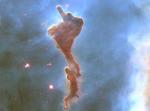 Disappearing Clouds in Carina
30.06.2003
This dense cloud of gas and dust is being deleted. Likely, within a few million years, the intense light from bright stars will have boiled it away completely. Stars not yet formed in the molecular cloud's interior will then stop growing.
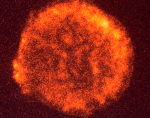 Tychos Supernova Remnant in X ray
7.03.1999
How often do stars explode? By looking at external galaxies, astronomers can guess that these events, known as a supernovae, should occur about once every 30 years in a typical spiral galaxy like our MilkyWay.
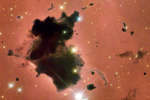 Thackerays Globules
28.12.2008
Rich star fields and glowing hydrogen gas silhouette dense, opaque clouds of interstellar gas and dust in this Hubble Space Telescope close-up of IC 2944, a bright star forming region in Centaurus, 5,900 light-years away. The largest of these dark globules, first spotted by South African astronomer A. D.
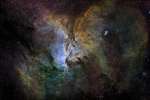 Shaping NGC 6188
2.05.2008
Dark shapes with bright edges winging their way through dusty NGC 6188 are tens of light-years long. The emission nebula is found near the edge of an otherwise dark large molecular cloud in the southern constellation Ara, about 4,000 light-years away.
|
January February March April May June July August September October |
|||||||||||||||||||||||||||||||||||||||||||||||||