
|
Keyword: star formation
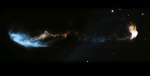 HH 47: A Young Star Jet Expands
5.09.2011
Stars remain where they are. Nebulas appear the same. Day after day. Year after year. Given the vast distances in astronomy, even fast moving objects will not appear to change their appearance in a human lifetime. Typically. A recent spectacular exception to this, however, is the supersonic jet in the star forming Herbig Haro 47.
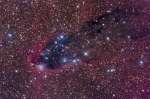 The Dark Tower in Scorpius
8.05.2008
In silhouette against a crowded star field toward the constellation Scorpius, this dusty cosmic cloud evokes for some the image of an ominous dark tower. In fact, clumps of dust and molecular gas collapsing...
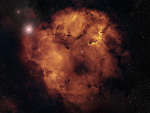 Monsters of IC 1396
25.04.2011
Is there a monster in IC 1396? Known to some as the Elephant's Trunk Nebula, parts of the glowing gas and dust clouds of this star formation region may appear to take on foreboding forms, some nearly human. The entire nebula might even look like a face of a monster.
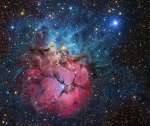 A Beautiful Trifid
13.05.2011
The beautiful Trifid Nebula is a cosmic study in colorful contrasts. Also known as M20, it lies about 5,000 light-years away toward the nebula rich constellation Sagittarius. A star forming region...
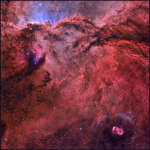 NGC 6188 and NGC 6164
28.12.2012
Fantastic shapes lurk in clouds of glowing hydrogen gas in NGC 6188, about 4,000 light-years away. The emission nebula is found near the edge of a large molecular cloud unseen at visible wavelengths, in the southern constellation Ara.
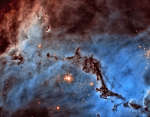 N11: Star Clouds of the LMC
11.02.2013
Massive stars, abrasive winds, mountains of dust, and energetic light sculpt one of the largest and most picturesque regions of star formation in the Local Group of Galaxies. Known as N11, the region...
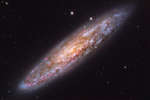 NGC 253: Dusty Island Universe
6.11.2025
Shiny NGC 253 is one of the brightest spiral galaxies visible, and also one of the dustiest. Some call it the Silver Coin Galaxy for its appearance in small telescopes, or just the Sculptor Galaxy for its location within the boundaries of the southern constellation Sculptor.
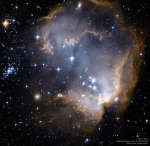 NGC 602 and Beyond
16.05.2021
The clouds may look like an oyster, and the stars like pearls, but look beyond. Near the outskirts of the Small Magellanic Cloud, a satellite galaxy some 200 thousand light-years distant, lies 5 million year young star cluster NGC 602.
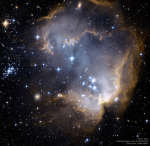 APOD: 2026 April 13 Б NGC 602 and Beyond
13.04.2026
The clouds may look like an oyster, and the stars like pearls, but look beyond. Near the outskirts of the Small Magellanic Cloud, a satellite galaxy some 200 thousand light-years distant, lies 5 million year young star cluster NGC 602.
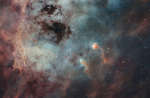 APOD: 2026 March 17 Б The Tadpoles of IC 410
17.03.2026
This telescopic close-up shows off the central regions of otherwise faint emission nebula IC 410, captured under backyard skies. Presented in a Hubble color palette, the image combines visible broadband and narrowband data with data from the near-infrared. Below and right of center are two remarkable inhabitants of the interstellar pond of gas and dust.
|
January February March April May June July August September October |
|||||||||||||||||||||||||||||||||||||||||||||||||