
|
Keyword: star formation
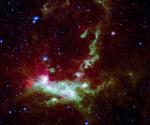 Henize 206: Cosmic Generations
11.03.2004
Peering into a dusty nebula in nearby galaxy the Large Magellanic Cloud, infrared cameras on board the Spitzer Space Telescope recorded this detailed view of stellar nursery Henize 206 filled with newborn stars. The stars appear as white spots within the swirls of dust and gas in the false-color infrared image.
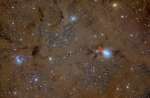 Stardust in Perseus
4.02.2010
This cosmic expanse of dust, gas, and stars covers close to 3 degrees on the sky in the heroic constellation Perseus. Right of center in the gorgeous skyscape is the dusty blue reflection nebula NGC 1333, about 1,000 light-years away. At that estimated distance, the field of view is about 50 light-years across.
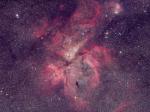 NGC 3372: The Great Nebula in Carina
17.05.2004
In one of the brightest parts of the Milky Way lies a nebula where some of the oddest things occur. NGC 3372, known as the Great Nebula in Carina, is home to massive stars and changing nebula.
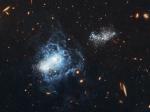 I Zwicky 18: The Case of the Aging Galaxy
17.10.2007
How old is this galaxy? The galaxy on the left, I Zwicky 18, was once thought to be one of the youngest galaxies on record since its bright stars indicated an age of only 500 million years.
 A Radio Vista of Cygnus
18.02.2002
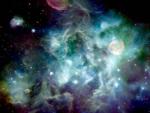
Shells of ancient supernovas, cocoons surrounding newborn stars, and specks from distant quasars highlight this tremendous vista toward the constellation of Cygnus. The representative color image covers about 10 degrees across on the sky but is only a small part of the Canadian Galactic Plane Survey in radio light.
 M94: Beyond the Blue
13.06.2001
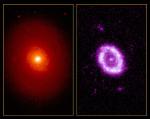
Today's galaxy, M94 (NGC 4736), lies 15 million light-years away in the constellation Canes Venatici. In the red light image (left), its very bright nucleus and tightly wound spiral arms seem to slowly fade into a faint outer disk.
 M94: A New Perspective
14.01.2010
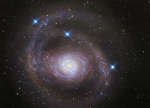
Beautiful island universe M94 lies a mere 15 million light-years distant in the northern constellation of the hunting dogs, Canes Venatici. A popular target for astronomers the brighter inner part of the face-on spiral galaxy is about 30,000 light-years across.
 NGC 253: Dusty Island Universe
21.04.2006
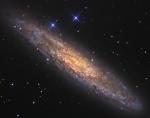
Shiny NGC 253, sometimes called the Silver Dollar Galaxy, is one of the brightest spiral galaxies visible - and also one of the dustiest. First swept up in 1783 by mathematician and astronomer Caroline Herschel, the dusty island universe lies a mere 10 million light-years away in the southern constellation Sculptor.
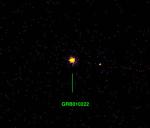 GRB010222: Gamma Ray Burst, X Ray Afterglow
13.04.2001
A fading afterglow from one of the most powerful explosions in the universe is centered in this false color image from the spacebased Chandra X-ray Observatory. The cosmic explosion, an enormously bright gamma-ray burst (GRB), originated in a galaxy billions of light-years away and was detected by the BeppoSAX satellite on February 22.
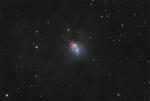 Dusty NGC 1300
6.10.2006
Dusty NGC 1333 is seen in visible light as a reflection nebula, dominated by bluish hues characteristic of starlight reflected by dust. But at longer infrared wavelengths, the interstellar dust itself glows. Moving your...
|
January February March April May June July August September October |
|||||||||||||||||||||||||||||||||||||||||||||||||