
|
Keyword: star formation
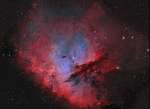 Portrait of NGC 281
25.08.2011
Look through the cosmic cloud cataloged as NGC 281 and it's almost easy to miss stars of open cluster IC 1590. But, formed within the nebula, that cluster's young, massive stars ultimately power the pervasive nebular glow.
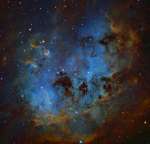 The Tadpoles of IC 410
16.04.2011
This telescopic close-up shows off the otherwise faint emission nebula IC 410 in striking false-colors. It also features two remarkable inhabitants of the cosmic pond of gas and dust above and left of center, the tadpoles of IC 410. The picture is a composite of images taken through both broad and narrow band filters.
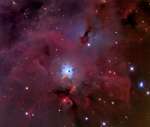 NGC 1999: South of Orion
24.02.2011
South of the large star-forming region known as the Orion Nebula, lies bright blue reflection nebula NGC 1999. Also at the edge of the Orion molecular cloud complex some 1,500 light-years distant, NGC 1999's illumination is provided by the embedded variable star V380 Orionis.
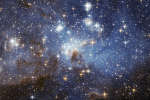 Star Forming Region LH 95
12.03.2008
How do stars form? To better understand this complex and chaotic process, astronomers used the Hubble Space Telescope to image in unprecedented detail the star forming region LH 95 in the nearby Large Magellanic Cloud galaxy.
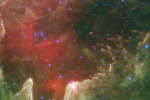 W5: Pillars of Star Creation
16.09.2008
How do stars form? A study of star forming region W5 by the orbiting Spitzer Space Telescope provides clear clues by recording that massive stars near the center of empty cavities are older than stars near the edges.
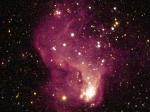 Star Forming Region Hubble V
25.12.2001
How did stars form in the early universe? Astronomers are gaining insight by studying NGC 6822, a nearby galaxy classified as irregular by modern standards but appearing more typical of galaxies billions of years ago. Inspection of NGC 6822 shows several bright star groups, including two dubbed Hubble-X and Hubble-V.
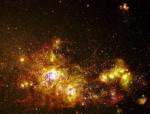 NGC 4214: Star Forming Galaxy
7.01.2000
Dazzling displays of star formation abound across the face of galaxy NGC 4214, a mere 13 million light-years away in the northern constellation Canes Venatici. While this 1997 Hubble Space Telescope image shows...
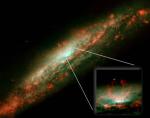 The Bubbling Cauldron of NGC 3079
16.10.2004
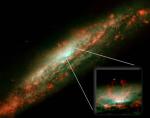
Edge-on spiral galaxy NGC 3079 is a mere 50 million light-years away toward the constellation Ursa Major. Shown in this stunning false-color Hubble Space Telescope image, the galaxy's disk - composed of spectacular star clusters in winding spiral arms and dramatic dark lanes of dust - spans some 70,000 light-years.
 The Bubbling Cauldron of NGC 3079
22.08.2001
Edge-on spiral galaxy NGC 3079 is a mere 50 million light-years away toward the constellation Ursa Major. Shown in this stunning false-color Hubble Space Telescope image, the galaxy's disk - composed of spectacular star clusters in winding spiral arms and dramatic dark lanes of dust - spans some 70,000 light-years.
 In the Center of 30 Doradus
21.02.1999
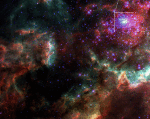
In the center of 30 Doradus lies a huge cluster of the largest, hottest, most massive stars known. The center of this cluster, known as R136, is boxed in the upper right portion of the above picture.
|
January February March April May June July August September October |
|||||||||||||||||||||||||||||||||||||||||||||||||