
|
Keyword: comet
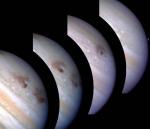 Jupiter Swallows Comet Shoemaker Levy 9
5.11.2000
What happens when a comet encounters a planet? If the planet has a rocky surface, a huge impact feature will form. A giant planet like Jupiter, however, is mostly gas. When Comet Shoemaker-Levy 9 struck Jupiter in 1994, each piece was swallowed into the vast Jovian atmosphere.
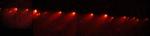 A String Of Pearls
24.07.2004
Comet Shoemaker-Levy 9, named after its co-discoverers, was often referred to as the "string of pearls" comet. It is famous for its suggestive appearance as well as its collision with the planet Jupiter!
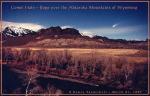 Comet Country
27.03.1997
Moonlight illuminates the landscape and lends a painterly quality to this beautiful photograph of the Absaroka mountain range, located along the Montana-Wyoming border near the USA's Yellowstone National Park. In the foreground lies the North Fork of the Shoshone River.
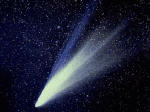 Two Tails of Comet West
26.08.1995
Here Comet West is seen showing two enormous tails that wrap around the sky. The ion tale of a comet usually appears more blue and always points away from the Sun. The dust tail trailing the comet's nucleus is the most prominent.
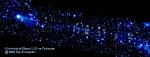 Comet 57P Falls to Pieces
2.08.2002
Comet 57P has fallen to pieces, at least 19 of them. Orbiting the Sun every 5.9 years or so this faint comet - also christened Comet 57P/du Toit-Neujmin-Delporte for its three 1941 co-discoverers - is simply...
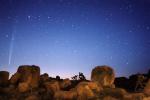 Comets Bradfield and LINEAR Rising
3.05.2004
Comet Bradfield is easy to see on the left, but can you find Comet LINEAR on the right? Last week, just before sunrise from the northern hemisphere, two bright comets were visible in the same part of the sky at the same time.
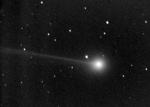 Comet Ikeya Zhang
21.02.2002
Comet Ikeya-Zhang is presently heading north in planet Earth's sky, framed by stars of the constellation Cetus. The comet was discovered as a faint, telescopic object near the western horizon on the evening...
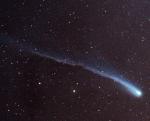 Comet Ikeya Zhang Brightens
7.03.2002
In the last week, Comet Ikeya-Zhang has become bright enough to be just visible to the unaided eye. Based on its present activity, observers are optimistic that Ikeya-Zhang will become substantially brighter. This composite...
 Comet SWAN Outburst
28.10.2006
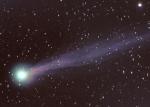
Near its closest approach to planet Earth, comet SWAN (C/2006 M4) brightened unexpectedly earlier this week, becoming visible to naked-eye observers under dark night skies. Telescopic observers also noticed dramatic changes in the comet's colorful coma and tail, seen in this view recorded on October 25th.
 X-Rays from Comet LINEAR
1.08.2000
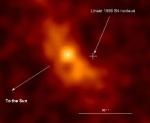
Why do comets emit X-rays? First discovered during the passing of Comet Hyakutake in 1996, the reason a cold comet would produce hot X-rays has since remained a mystery. On July 14, however...
|
January February March April May June July August September October |
|||||||||||||||||||||||||||||||||||||||||||||||||