
|
Keyword: comet
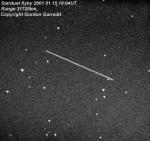 Sail On Stardust
24.01.2001
Spacecraft on long interplanetary voyages often use the planets themselves as gravitational "sling shots" to boost them along their way. Launched in February of 1999 on a historic voyage to a comet, the Stardust spacecraft is no different.
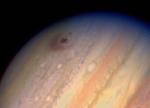 Impact on Jupiter
28.07.1998
In 1993, a strange string of comet pieces was discovered near the planet Jupiter. So unusual a sight, Comet Shoemaker-Levy 9 (SL9) quickly became the object of much scientific curiosity. Studies showed that the Sun would soon perturb the orbit of SL9 so that it would actually
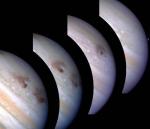 Jupiter Swallows Comet Shoemaker Levy 9
4.08.1998
What happens when a comet encounters a planet? If the planet has a rocky surface, a huge impact feature will form. A giant planet like Jupiter, however, is mostly gas. When Comet Shoemaker-Levy 9 struck Jupiter in 1994, each piece was swallowed into the vast Jovian atmosphere.
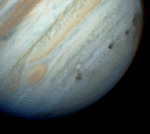 Comet Impacts on Jupiter
14.07.1995
In July of 1994, pieces of Comet Shoemaker-Levy 9, also known as the "string of pearls" comet, collided with the planet Jupiter. As the comet fragments smashed in to Jupiter, the resulting explosions scattered large quantities of dusty cometary debris into the Jovian atmosphere.
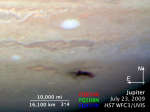 Hubble View: Jupiter Impact
31.07.2009
This sprawling dark marking is Jupiter's latest impact scar, a debris plume created as a small asteroid or comet disintegrated after plunging into the gas giant's atmosphere. Located in Jupiter's south polar region, the new feature was discovered by Australian amateur astronomer Anthony Wesley on July 19.
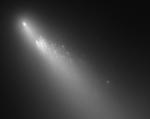 Schwassmann Wachmann 3: Fragment B
4.05.2006
Periodic comet 73P/Schwassmann-Wachmann 3 has fallen apart before. A cosmic souffle of ice and dust left over from the early solar system, this comet was seen to split into several large pieces during the close-in part of its orbit in 1995.
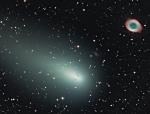 Comet Meets Ring Nebula: Part I
11.05.2006
As dawn approached on May 8, astronomer Stefan Seip carefully watched Fragment C of broken comet 73P/Schwassmann-Wachmann 3 approach M57 - the Ring Nebula, and faint spiral galaxy IC 1296. Of course, even though...
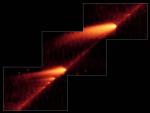 Crumbling Comet
13.05.2006
This false-color mosaic of crumbling comet Schwassmann-Wachmann 3 spans about 6 degrees (12 full moons) along the comet's orbit. Recorded on May 4-6 by an infrared camera on board the Spitzer Space Telescope, the picture captures about 45 of the 60 or more alphabetically cataloged large comet fragments.
 Comet Machholz in View
4.01.2005
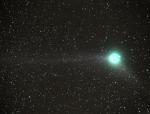
Good views of Comet Machholz are in store for northern hemisphere comet watchers in January. Now making its closest approach to planet Earth, the comet will pass near the lovely Pleiades star cluster on January 7th and the double star cluster in Perseus on January 27th as Machholz moves relatively quickly through the evening sky.
 Announcing Comet Machholz
12.12.2004
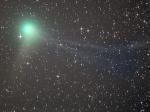
A comet discovered only this summer is brightening quickly and already visible to the unaided eye. Comet C/2004 Q2 (Machholz) is currently best visible in Earth's Southern Hemisphere where some observers report it brighter than magnitude 5. The comet is moving rapidly to northern skies and should continue to brighten until early January.
|
January February March April May June July August September October |
|||||||||||||||||||||||||||||||||||||||||||||||||