
|
Keyword: comet
 APOD: 2025 November 17 Б Comet Lemmons Wandering Tail
17.11.2025
What has happened to Comet Lemmon's tail? The answer is blowing in the wind Б the wind from the Sun in this case. This continuous outflow of charged particles from...
 APOD: 2025 December 30 Б An Artificial Comet
30.12.2025
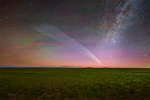
Yes, but can your comet tail do this? No, and what you are seeing is not the tail of a comet. The picture features a cleverly overlayed time-lapse sequence of a group of satellites orbiting Earth together in June.
 Comet ATLAS and Orion s Belt
12.11.2020
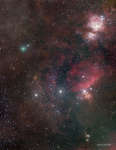
With its closest approach to planet Earth scheduled for November 14, this Comet ATLAS (C/2020 M3) was discovered just this summer, another comet found by the NASA funded Asteroid Terrestrial-impact Last Alert System.
 Comet ZTF over Mount Etna
28.01.2023
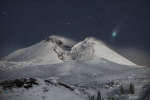
Comet-like plumes are blowing over the volcanic peaks of Mount Etna in this wintry mountain-and-skyscape from planet Earth. The stacked and blended combination of individual exposures recorded during the cold night of January 23, also capture naked-eye Comet ZTF just above Etna's snowy slopes.
 APOD: 2023 January 31 Б A Triple View of Comet ZTF
31.01.2023
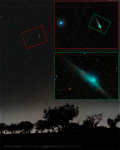
Comet ZTF has a distinctive shape. The now bright comet visiting the inner Solar System has been showing not only a common dust tail, ion tail, and green gas coma, but also an uncommonly distinctive antitail.
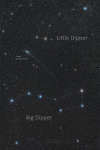 APOD: 2023 February 7 Б A Comet and Two Dippers
7.02.2023
Can you still see the comet? Yes. Even as C/2022 E3 (ZTF) fades, there is still time to see it if you know where and when to look. Geometrically, Comet ZTF has passed its closest to both the Sun and the Earth and is now headed back to the outer Solar System.
 APOD: 2025 January 13 Б Comet ATLAS Before Sunrise
13.01.2025
Comet ATLAS is really bright now, but also really close to the Sun. Outside the glow of the Sun, Comet C/2024 G3 (ATLAS) would be one of the more remarkable comet sights of recent years, reflecting about as much sunlight to Earth as Comet Tsuchinshan-ATLAS did in October, and now rivaling even planet Venus.
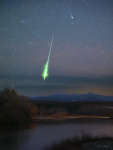 The Comet and the Fireball
20.12.2021
This picture was supposed to feature a comet. Specifically, a series of images of the brightest comet of 2021 were being captured: Comet Leonard. But the universe had other plans. Within a fraction of a second, a meteor so bright it could be called a fireball streaked through just below the comet.
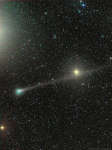 Rosetta s Comet in Gemini
13.11.2021
Returning along its 6.4 year orbit, periodic comet Churyumov-Gerasimenko (67P) is caught in this telescopic frame from November 7. Sweeping past background stars in the constellation Gemini the comet's dusty tail stretches toward the upper right to Upsilon Geminorum.
 Comet Leonard from Space
15.12.2021
What does Comet Leonard look like from space? Today's featured image from Origin.Space's Yangwang-1 space telescope shows not only the currently bright comet -- but several other space delights as well. Taken...
|
January February March April May June July August September October |
|||||||||||||||||||||||||||||||||||||||||||||||||