
|
Keyword: Mars
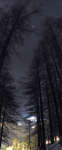 Mars Over the Allalinhorn
8.03.2010
What's that bright object in the sky? A common question with answers that vary by time and season, the quick answer just after sunset in middle of last month, from the norther hemisphere, was Mars.
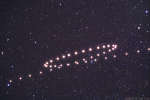 Retrograde Mars
13.06.2010
Why would Mars appear to move backwards? Most of the time, the apparent motion of Mars in Earth's sky is in one direction, slow but steady in front of the far distant stars. About every two years, however, the Earth passes Mars as they orbit around the Sun.
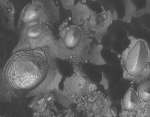 Layered Hills in Arabia Terra on Mars
15.08.2010
Why are some hills on Mars so layered? The answer is still under investigation. Clearly, dark windblown sand surrounds outcropping of light sedimentary rock across the floor of crater Arabia Terra. The light rock clearly appears structured into many layers, the lowest of which is likely very old.
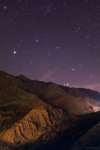 Regulus and the Red Planet
10.06.2010
Leo's royal star Regulus and red planet Mars appear in a colorful pairing just above the horizon in this starry skyscape. The photo was taken on June 4th from Oraman, a mountainous region of Kurdistan in western Iran near the border with Iraq.
 Ecliptic New Zealand
10.07.2010
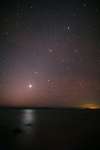
Four bright celestial beacons and a faint triangle of light follow the plane of the ecliptic as it arcs high through this southern hemisphere night skyscape. Seen on a July winter night from Lake...
 Big Mars from Hubble
27.08.2003
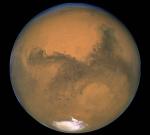
At about 10 am Universal Time today, Mars and Earth will pass closer than in nearly 60,000 years. Mars, noticeably red, will be the brightest object in the eastern sky just after sunset.
 A Dark Dune Field in Proctor Crater on Mars
22.11.2010
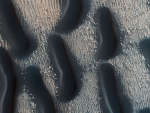
Was this image taken with a telescope or a microscope? Perhaps this clue will help: if the dark forms were bacteria, they would each span over football field across. What is actually being seen are large sand dunes on the floor of Proctor Crater on Mars.
 Retrograde Mars
11.05.2008
Why would Mars appear to move backwards? Most of the time, the apparent motion of Mars in Earth's sky is in one direction, slow but steady in front of the far distant stars. About every two years, however, the Earth passes Mars as they orbit around the Sun.
 Phobos from Mars Express
17.03.2010
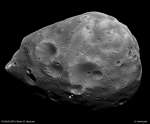
Why is this small object orbiting Mars? The origin of Phobos, the larger of the two moons orbiting Mars, remains unknown. Phobos and Deimos appear very similar to C-type asteroids, yet gravitationally capturing such asteroids, circularizing their orbits, and dragging them into Mars' equatorial plane seems unlikely.
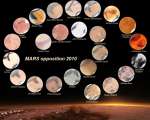 The Faces of Mars
5.05.2010
Enthusiastic astro-artists ranging from expert to beginner, the youngest age 10, all contributed their work to this entertaining panel featuring different faces of Mars. Their sketches are all based on telescopic views of the Red Planet from earlier this year, near its 2010 opposition.
|
January February March April May June July August September October |
|||||||||||||||||||||||||||||||||||||||||||||||||