
|
Keyword: Moon
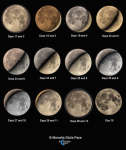 Moon Pairs and the Synodic Month
26.09.2020
Observe the Moon each night and its visible sunlit portion will gradually change. In phases progressing from New Moon to Full Moon to New Moon again, a lunar cycle or synodic month is completed in about 29.5 days.
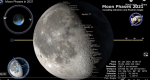 Moon Phases in 2021
11.01.2021
What will the Moon phase be on your birthday this year? It is hard to predict because the Moon's appearance changes nightly. As the Moon orbits the Earth, the half illuminated by the Sun first becomes increasingly visible, then decreasingly visible.
 APOD: 2025 August 23 Б Fishing for the Moon
23.08.2025
How big is planet Earth's Moon? Compared to other moons of the Solar System, it's number 5 on the largest to smallest ranked list, following Jupiter's moon Ganymede, Saturn's moon Titan, and Jovian moons Callisto and Io. Continuing the list, the Moon comes before Jupiter's Europa and Neptune's Triton.
 APOD: 2025 July 20 Б Lunar Nearside
20.07.2025
About 1,300 images from the Lunar Reconnaissance Orbiter spacecraft's wide angle camera were used to compose this spectacular view of a familiar face - the lunar nearside. But why is there a lunar nearside? The Moon rotates on its axis and orbits the Earth at the same rate, about once every 28 days.
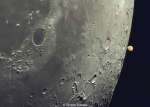 APOD: 2020 August 15 Б Mars at the Moons Edge
15.08.2020
Does the Moon ever block out Mars? Yes, the Moon occasionally moves in front of all of the Solar System's planets. Just this past Sunday, as visible from some locations in South America, a waning gibbous Moon eclipsed Mars.
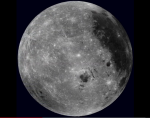 Rotating Moon from LRO
19.07.2020
No one, presently, sees the Moon rotate like this. That's because the Earth's moon is tidally locked to the Earth, showing us only one side. Given modern digital technology, however, combined with many detailed images returned by the Lunar Reconnaissance Orbiter (LRO), a high resolution virtual Moon rotation movie has been composed.
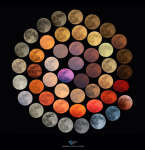 Colors of the Moon
11.11.2020
What color is the Moon? It depends on the night. Outside of the Earth's atmosphere, the dark Moon, which shines by reflected sunlight, appears a magnificently brown-tinged gray. Viewed from inside the Earth's atmosphere, though, the moon can appear quite different.
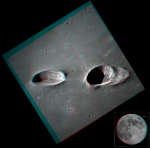 APOD: 2026 May 9 Б Messier Craters in Stereo
9.05.2026
Many bright nebulae and star clusters in planet Earth's sky are associated with the name of astronomer Charles Messier from his famous 18th century catalog. His name is also given to these two large and remarkable craters on the Moon.
 APOD: 2025 April 22 Б Terminator Moon: A Moonscape of Shadows
22.04.2025
What's different about this Moon? It's the terminators. In the featured image, you can't directly see any terminator -- the line that divides the light of day from the dark of night. That's because the featured image is a digital composite of many near-terminator lunar strips over a full Moon.
 Moon Near the Edge
12.04.2025
Most of us watch the Moon at night. But the Moon spends nearly as many daylight hours above our horizon, though in bright daytime skies the lunar disk looks pale and can be a little harder to see.
|
January February March April May June July August September October |
|||||||||||||||||||||||||||||||||||||||||||||||||