
|
Keyword: Perseids
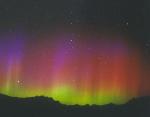 Meteors and Northern Lights
15.08.2002
Skygazers report that the annual Perseid meteor shower went pretty much as predicted, producing a meteor every few minutes during the dark early morning hours of August 12 and 13. And as the constellation...
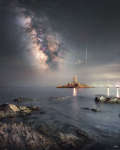 Meteor and Milky Way over the Mediterranean
23.08.2022
Careful planning made this a nightscape to remember. First, the night itself was chosen to occur during the beginning of this year's Perseid Meteor Shower. Next, the time of night was chosen to be before the bright Moon would rise and dominate the night sky's brightness.
 Night of the Perseids
28.09.2021
Have you ever experienced a meteor shower? To help capture the wonder, a video was taken during the peak of the recent Perseid meteor shower above the Indian Astronomical Observatory in Hanle, India, high up in the Himalayan mountains.
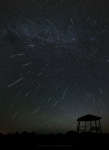 Perseid Outburst at Westmeath Lookout
24.09.2021
This year an outburst of Perseid meteors surprised skywatchers. The reliable meteor shower's peak was predicted for the night of August 12/13. But persistent visual observers in North America were deluged with...
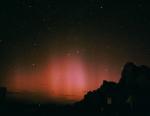 Aurora In West Texas Skies
15.09.2000
The aurora borealis, or northern lights, are not a common sight in the southwestern United States. But a strong solar coronal mass ejection in early August triggered geomagnetic storms and aurora which were widely reported, even under west Texas skies.
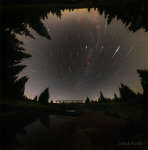 APOD: 2026 August 18 Б Perseids from Perseus
18.08.2026
This was a good year for the Perseids meteor shower. A key reason was the Moon was absent from lighting up Earth's night sky so that more meteors were visible than usual. Where was the Moon? It was busy visiting the Sun.
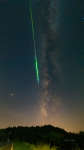 A Perseid Meteor and the Milky Way
3.08.2021
It was bright and green and flashed as it moved quickly along the Milky Way. It left a trail that took 30 minutes to dissipate. Given the day, August 12, and the direction, away...
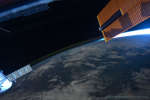 A Perseid Below
8.08.2021
Earthlings typically watch meteor showers by looking up. But this remarkable view, captured on August 13, 2011 by astronaut Ron Garan, caught a Perseid meteor by looking down. From Garan's perspective onboard...
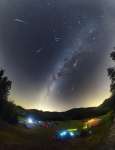 Night of the Perseids
10.08.2017
This weekend, meteors will rain down near the peak of the annual Perseid Meteor Shower. Normally bright and colorful, the Perseid shower meteors are produced by dust swept up by planet Earth from the orbit of Comet Swift-Tuttle. They streak from a radiant in Perseus, above the horizon in clear predawn skies.
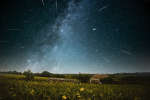 Three Perseid Nights
20.08.2021
Frames from a camera that spent three moonless nights under the stars create this composite night skyscape. They were recorded during August 11-13 while planet Earth was sweeping through the dusty trail of comet Swift-Tuttle.
|
January February March April May June July August September October |
|||||||||||||||||||||||||||||||||||||||||||||||||