
|
APOD: 2026 August 25 Б Earths Shadow Visualized with Lunar Eclipses
| << Yesterday | 25.08.2026 | Tomorrow >> |

Credit & Copyright: Tim Martin
Explanation:
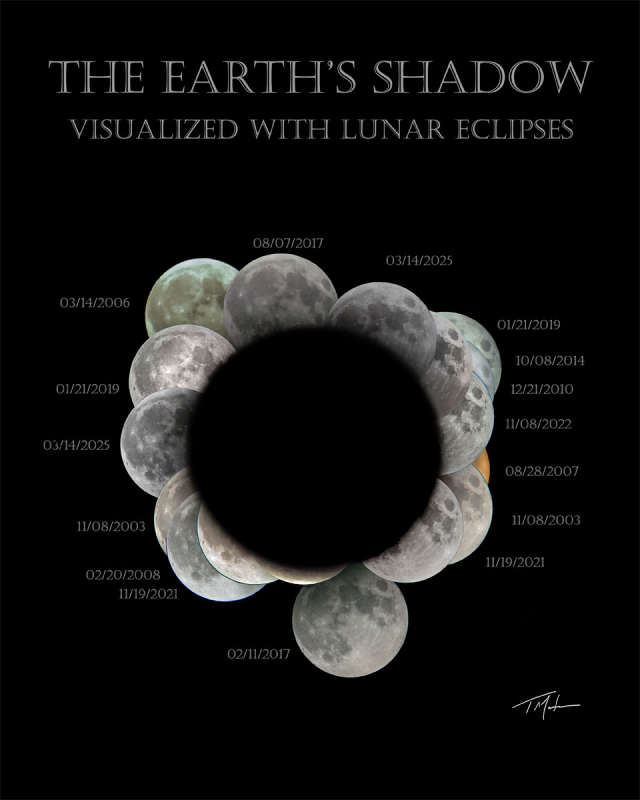
WhatБs creating this giant hole in space?
This is not a
black hole Б itБs a shadow.
ItБs EarthБs shadow.
Since at least the time of
Aristotle,
people have noted that
Earth's dark shadow on the
Moon during a partial
lunar eclipse is circular -- although never a
whole circle.
Using modern digital technology, though,
the images of multiple
lunar eclipses can be combined to show Earth's complete shadow.
The featured image compilation by a perseistent astrophotographer
is constructed from 22 years of lunar eclipses.
The Moon is not
eclipsed every month
(moon-th) because the
Moon's orbit is
slightly tilted relative to Earth's orbit.
Close inspection of some lunar eclipse images shows a
faint
blue
band where
EarthБs atmosphere filters out more red sunlight than blue.
Later this week, a
new lunar eclipse will occur and will be
best visible in parts of North and South America, Europe, and Africa.
APOD's main NASA site is
moving :
From apod.nasa.gov to
science.nasa.gov/apod
|
January February March April May June July August September October |
| |||||||||||||||||||||||||||||||||||||||||||||||||||||||
NASA Web Site Statements, Warnings, and Disclaimers
NASA Official: Jay Norris. Specific rights apply.
A service of: LHEA at NASA / GSFC
& Michigan Tech. U.
Based on Astronomy Picture
Of the Day
Publications with keywords: lunar eclipse - Moon
Publications with words: lunar eclipse - Moon
See also: