|
Peremennye Zvezdy (Variable Stars) 46, No. 2, 2026 Received 14 May; accepted 17 June. |
Article in PDF |
|
DOI: 10.24412/2221-0474-2026-46-13-25
|
V5845 Sagittarii: A New RR(B) RRab Mode-switching RR
Lyrae Star
RRab Mode-switching RR
Lyrae Star
A. V. Khruslov1,2
- Sternberg Astronomical Institute, Moscow State University,
Universitetskij pr. 13, Moscow 119992, Russia;
khruslov@bk.ru
- Institute of Astronomy, Russian Academy of Sciences, Pyatnitskaya str. 48, Moscow 119017, Russia
| I report the discovery of a new case of an RR Lyrae star that experienced a switching of its pulsation mode. The variable V5845 Sgr was previously known as a double-mode RR Lyrae star. My analysis of available photometric archives shows that, after the date JD 2459350, a rapid transition from double-mode pulsations to mono-periodicity occurred. Currently, the variable is a fundamental-mode RRab star, with no sign of the first-overtone pulsation. |
1. Introduction
Since the first case of mode switching in an RR Lyrae star, V79 in the globular cluster M3 (Kaluzny et al. 1998; Goranskij et al. 2010), several authors reported their detection of such variables: Soszynski et al. (2014a), OGLE-BLG-RRLYR-12245; Soszynski et al. (2014b), OGLE-BLG-RRLYR-07226 and OGLE-BLG-RRLYR-13442; Poleski (2014), a star in the Large Magellanic Cloud, OGLE-LMC-RRLYR-13308.
Besides, Drake et al. (2014), in the sample observed by the Catalina Surveys, and Kains et al. (2015), in the globular cluster M68, suggested several candidates for pulsation mode switching among RR Lyrae stars. However, these cases require confirmation.
Khruslov et al. (2017) discovered a case of pulsation mode switching in an RR Lyrae variable star, USNO-B1.0 1171-0309158.
In this paper, I report the discovery of a new case of a mode-switching RR Lyrae star.
2. History of studies of V5845 Sgr
In this paper, I investigate the variable star V5845 Sgr =
USNO-B1.0 0667-0901820 = GSC2.4 SC3K033286, RA(J2000) =
19 52
52 26
26 883, Dec(J2000) = -23
 17
17 54
54
 39. The
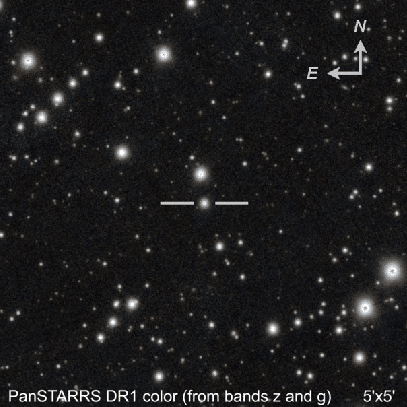
finding chart of V5845 Sgr is displayed in Fig. 1.
39. The
finding chart of V5845 Sgr is displayed in Fig. 1.
Keller et al. (2008) first classified the star as an RR Lyrae variable. Based on this paper, the star was included in the International Variable Star Index (VSX, AAVSO) as a possible RRc star, with the object name SEKBO 109453.71. In the VSX page for SEKBO 109453.71 (dated 2014-07-03), Sebastian Otero suspected the RRd type from Catalina surveys data. At the same time, Khruslov (2014) confirmed the existence of double-mode variations using 1SWASP data, which was complicated by blending with nearby stars. Both Otero and Khruslov identified the variable, USNO-B1.0 0667-0901820, with the suspected variable NSV 12483 of the New Catalogue of Suspected Variable Stars (NSV, Kukarkin et al. 1982).
Later, during the preparation of the variable for inclusion in the Name-list of the General Catalog of Variable Stars (GCVS, Samus et al. 2017), this identification was questioned by one of the authors of the catalogue (E. V. Kazarovets). She noted a significant difference in the properties of the variable in the paper of the discoverer (Luyten 1937) and the catalog values for USNO-B1.0 0667-0901820. Based on the assumption of a probable misprint in the coordinates (declination), NSV 12483 was identified with GSC 06891-00713 (Kazarovets & Pastukhova 2017), and later designation as V6550 Sgr (Kazarovets et al., 2019; see also comments for this variable in the GCVS).
USNO-B1.0 0667-0901820 was designated in GCVS as V5845 Sgr, classified as a double-mode RR Lyrae star, type RR(B) (Kazarovets et al. 2015); the light elements were given according to Khruslov (2014). Later, double periodicity (fundamental and first overtone modes, type RRd) for V5845 Sgr was confirmed in the Gaia DR2 (Gaia Collaboration, 2018) and Gaia DR3 (Gaia Collaboration, 2022b) catalogs, where the star is designated as Gaia DR2 6863908117597473408 = Gaia DR3 6863908117597473408.
As a single-period RRc variable (the first-overtone mode only), V5845 Sgr was included in the PS1 catalog of RR Lyrae stars (Sesar et al. 2017; the Simbad identification [SHM2017] J298.11203-23.29842) and in the ASAS-SN Catalog of Variable Stars: II (Jayasinghe et al. 2019), where it is named ASASSN-V J195226.88-231753.1. The Catalina Surveys Southern periodic variable star catalogue (Drake et al. 2017), the variable CRTS J195226.8-231754 = SSS J195226.8-231754 was classified as a rotating variable (type ROT) with a doubled period of the first overtone mode. In the ATLAS catalog of candidate variable stars (Heinze et al. 2018), the star is designated ATO J298.1120-23.2984 and classified as a dubious object ("star might not be a real variable"). Of course, this does not mean that the fundamental pulsation mode was absent: probably either the task of searching for a secondary period was not set, or large observational errors made such a search difficult.
Zhang et al. (2025) did not detect double periodicity of V5845 Sgr
from the Zwicky Transient Facility (ZTF) data. They found a period
 (fundamental mode), and the star was included
in the list of stars with potentially spurious Gaia secondary
periods. These authors did not include V5845 Sgr in their list of
double-mode RR Lyrae variables, but they do not consider this star
as a case of mode switching.
(fundamental mode), and the star was included
in the list of stars with potentially spurious Gaia secondary
periods. These authors did not include V5845 Sgr in their list of
double-mode RR Lyrae variables, but they do not consider this star
as a case of mode switching.
In the present study, I detect mode switching of V5845 Sgr of the
RR(B)RRab type (R01R0 type in the MMRP catalog
classification, Khruslov 2023).
3. Analysis of photometric data
3.1. Photometric archives
I analyzed all available photometric survey data: the Wide Angle Search for Planets (SuperWASP1, Butters et al. 2010), the Catalina Sky Surveys (CSS2, Drake et al. 2009), the All-Sky Automated Survey for Supernovae (ASAS-SN3, Shappee et al. 2014; Kochanek et al. 2017), the Zwicky Transient Facility (ZTF, Bellm et al. 2019; Masci et al. 2019), and the Gaia DR3 data (Gaia Collaboration, 2022a).
The SuperWASP observations are available as FITS tables, which were converted into ASCII tables using the OMC2ASCII4program as described by Sokolovsky (2007). The ZTF data were taken from the SNAD ZTF viewer5, Malanchev et al. (2021).
3.2. Presentation of results
The results of our photometric data analysis are presented in two
Tables. Table 1 presents the light elements (periods and epoch of
maxima) and parameters of light curves (semi-amplitude and M-m
asymmetry) of two oscillation in the time interval of stable
double periodicity. This includes observations from 1SWASP, SSS,
Gaia DR3, and ASAS-SN ( band).
Table 2 presents the elements and parameters in the time interval
during which the mode switch[ing] occurred. This includes
observations of ASAS-SN ( band) and ZTF. The mode switching
occurred near JD 2459350 so quickly that one can confidently
discriminate between two adjacent time intervals as that with
double periodicity and that with a single period. Figure 2 shows,
using ASAS-SN -band data as an example, the full amplitude
variations caused by the switching of the pulsation mode.
band) and ZTF. The mode switching
occurred near JD 2459350 so quickly that one can confidently
discriminate between two adjacent time intervals as that with
double periodicity and that with a single period. Figure 2 shows,
using ASAS-SN -band data as an example, the full amplitude
variations caused by the switching of the pulsation mode.
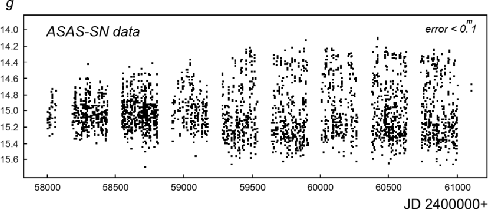 |
Fig. 2.
The light curve of V5845 Sgr from the
|
The elements for 1SWASP in the table are given according to my earlier paper (Khruslov 2014). In other cases, I have redetermined the light elements independently of the original publication. To avoid duplication of information, we also do not provide 1SWASP phased light curves here; they can be found in my cited paper.
For the double periodicity stage, I analyzed the photometric data using Deeming?s method (Deeming 1975) implemented in the WINEFK code6 written by V.P. Goranskij. This method is suitable for data analysis in the case of variables with quasi-sinusoidal light curves.
For the single-mode stage, I analyzed the photometric data using the Lafler-?Kinman method (Lafler & Kinman, 1965) implemented in the WINEFK code. This method is much more suitable for data analysis in the case of variables with strongly asymmetric light curves.
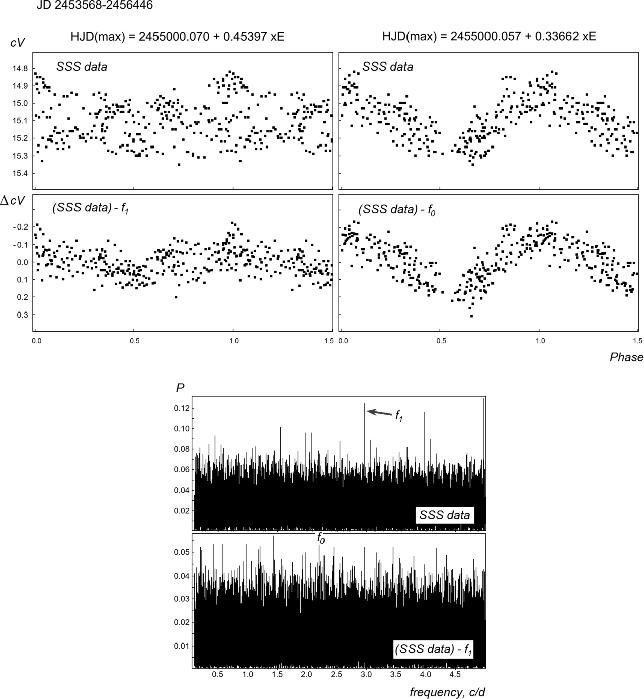
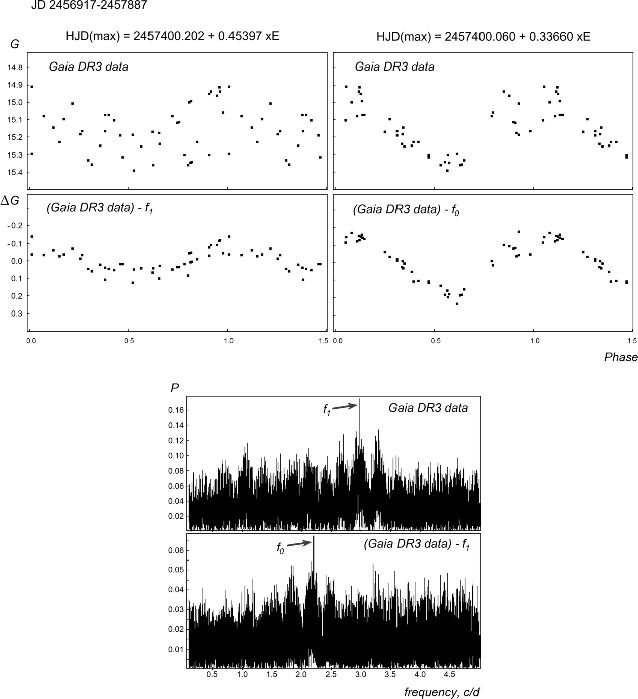
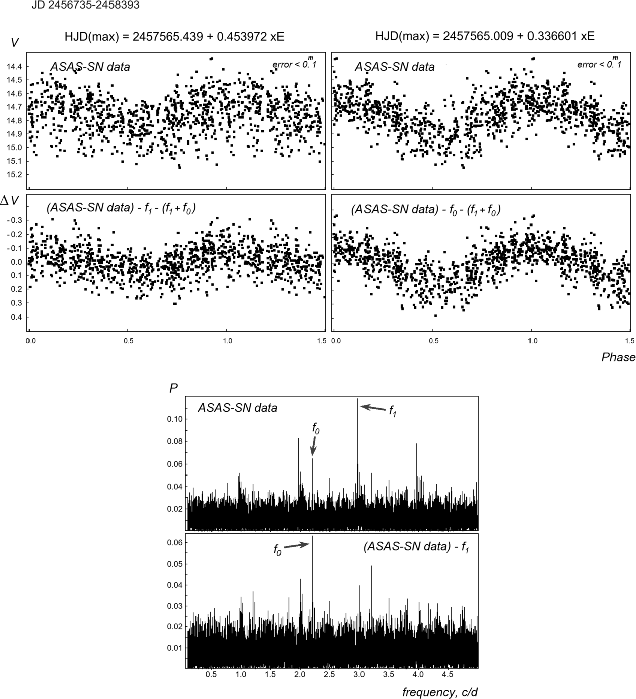
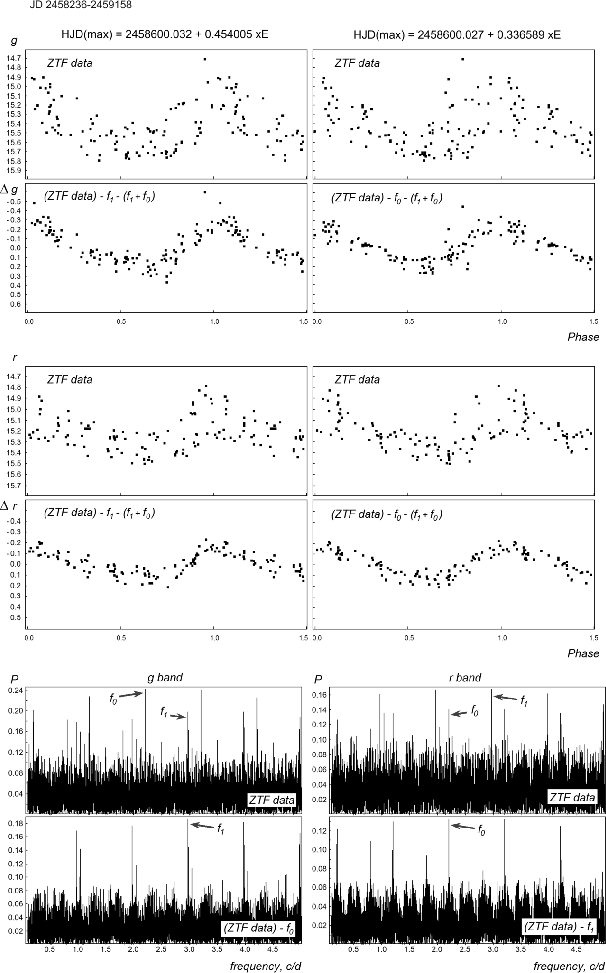
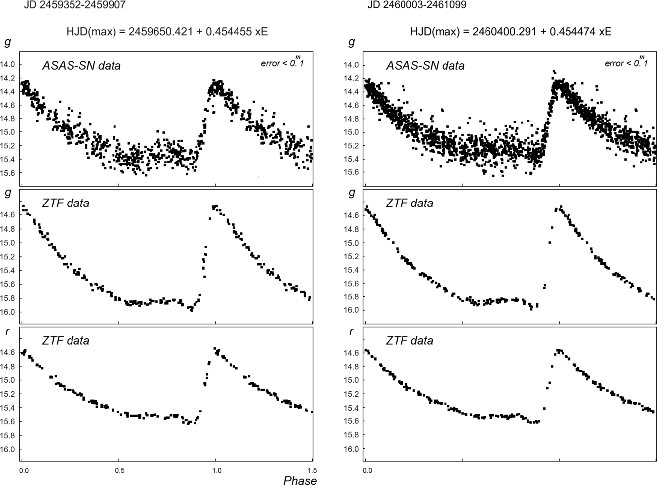
The data from all photometric surveys used in this study are available online in the html version of this paper as a zip-archive. The light curves and power spectra for the studied surveys and different time intervals are displayed in Figures 3-8.
Table 1. Light elements from 1SWASP, SSS, Gaia DR3 and
ASAS-SN -band data
-band data
| Source | Frequency | Period, days | Epoch, HJD | Semi-amplitude | M-m |
| 1SWASP |  |
0.45389 | 2454150.203 | 0.015* | 0.45: |
 |
0.33662 | 2454150.080 | 0.035* | 0.44 | |
| SSS | |
0.45397: | 2455000.070 | 0.051 | 0.50: |
|
0.33662 | 2455000.057 | 0.126 | 0.40 | |
| Gaia DR3 | |
0.45397 | 2457400.202 | 0.069 | 0.45 |
|
0.33660 | 2457400.060 | 0.158 | 0.41 | |
| ASAS-SN, |
|
0.453972 | 2457565.439 | 0.064 | 0.41 |
|
0.336601 | 2457565.009 | 0.119 | 0.46 |
3.3. Before JD 2459350: double-mode variability
Before JD 2459350, the star exhibited stable double-mode
oscillations in the fundamental and first-overtone modes. All
series of observations from Table 1 show the dominance of the
first overtone mode (the mean amplitude of the fundamental mode is
2.2 times smaller), which is characteristic of RR(B) stars. Also,
the M-m asymmetry parameter of the first-overtone light curve is
usually significantly smaller than this parameter for the
fundamental mode. However, these ratios begin to slowly change in
the ASAS-SN -band data.
The time interval for the 1SWASP data is JD 2453860-2454615. In this data, the semi-amplitude was underestimated due to blending (marked with an asterisk the Table 1).
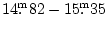
The time interval for the Catalina Surveys data is JD
2453568-2456446. The magnitude range is
 (C).
(C).
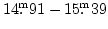
For the Gaia DR3 data, the time interval is JD 2456917-2457887
and the magnitude range, is
 (g
(g ).
).
The time interval for the -band ASAS-SN data is JD
2456735-2458393, with the magnitude range
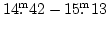 (a).
(a).
The first (I) time interval from Table 2 is JD 2458020-2459350
for a and JD 2458236-2459158 for z and z magnitudes. The
magnitude ranges are
magnitudes. The
magnitude ranges are
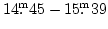 (ag),
(ag),
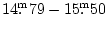 (z),
(z),
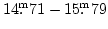 (z).
(z).
Table 2. Light elements from ASAS-SN -band and ZTF -
and -band data
-band and ZTF -
and -band data
| Time | Frequency | Period, days | Epoch, HJD |  (a) (a) |
(z) |
(z) |
M-m |
| interval | |||||||
| I | |
0.454005 | 2458600.032 | 0.141 | 0.133 | 0.228 | 0.39 |
|
0.336589 | 2458600.027 | 0.141 | 0.132 | 0.194 | 0.42 | |
| II | |
0.454455 | 2459650.421 | 0.530 | 0.545 | 0.730 | 0.12 |
|
- | - |  0.035 0.035 |
0.010 |
0.014 |
- | |
| III | |
0.454474 | 2460400.291 | 0.520 | 0.525 | 0.710 | 0.12 |
|
- | - |  0.034 0.034 |
0.008 |
0.011 |
- |
3.4. Since JD 2459350: mono-periodic variability
ASAS-SN and ZTF data since JD 2459350 show single-period variability characteristic of the RRab type (fundamental mode pulsations) of RR Lyrae stars. I did not find any traces of first-overtone oscillations.
During the single-period stage, the fundamental period varies by a small amount; for analysis, I subdivided the data into two time intervals, namely intervals II and III in Table 2.
However, during the first-overtone mode switch-off, the period varied by a significantly larger amount and abruptly (almost as a jump). In earlier publications on mode-switching RR Lyrae stars, this was already noted by other authors (see the Introduction). However, in the case of V5845 Sgr, the mode switch-off apparently occurred almost instantaneously, during several dozens of days only.
The second (II) time interval is JD 2459352-2459907. The
magnitude ranges are
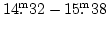 (a),
(a),
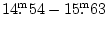 (z),
(z),
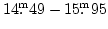 (z).
(z).
The third (III) time interval is JD 2460003-2461099. The
magnitude ranges are
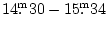 (a),
(a),
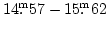 (z),
(z),
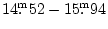 (z).
(z).
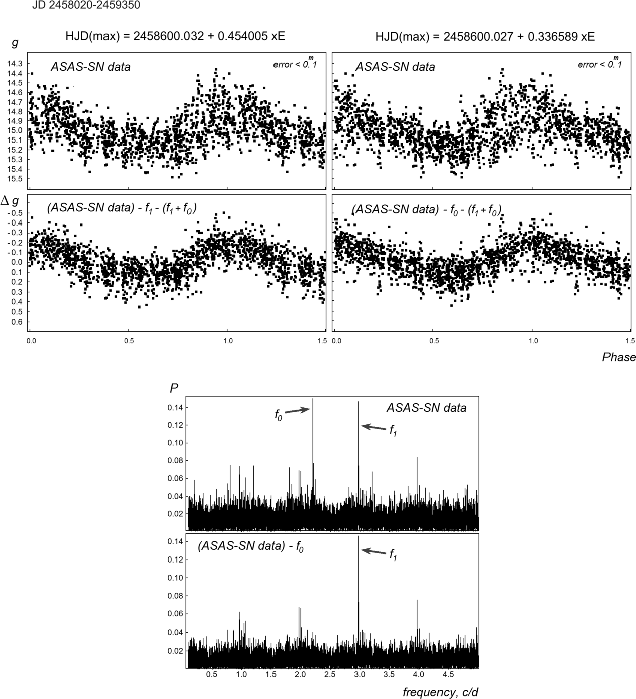 |
Fig. 6.
The light curves and power spectra of V5845
Sgr according to ASAS-SN data, |
|
Fig. 7.
The light curves and power spectra of V5845
Sgr according to ZTF data, |
Fig. 8.
The light curves of V5845 Sgr according to
ASAS-SN |
3.5. Conclusions
I detected a mode switching of V5845 Sgr, a known RR(B) star whose double periodicity I had previously discovered. Using the data of available photometric archives (ASAS-SN and ZTF), I found that pulsations in the first-overtone mode completely disappeared. After the mode switching, V5845 Sgr became a fundamental-mode RR Lyrae star, having changed its type from RR(B) to RRab.
Gradual changes took several years. They are characterized by variability of the pulsation amplitudes and changes of both periods (P1 decreased, P0 increased). However, rapid changes and transformation of the double-mode star into an RRab variable could occur within just few months near JD 2459350 (when the greatest changes in the above parameters occurred).
During all the time interval before JD 2459350, the first-overtone pulsations were gradually disappearing, and the fundamental-mode amplitude strongly increased. Near JD 2459350, the first-overtone mode was switched off, and at the same time, there was a sharp increase in the amplitude and period of the fundamental mode.
If the fundamental period changed by
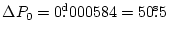 over the full time interval studied, then only near
JD 2459350 it increased by
over the full time interval studied, then only near
JD 2459350 it increased by
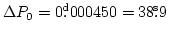 . This is in a very good agreement with other known cases of
mode-switching RR Lyrae stars.
. This is in a very good agreement with other known cases of
mode-switching RR Lyrae stars.
The period changes of V5845 Sgr are shown in Fig. 9.
The period ratio P1/P0 varies (gradually decreases) from 0.74163 (1SWASP) to 0.74138 (time interval I). The values of the period ratio are in a good agreement with those typical of RR(B) stars.
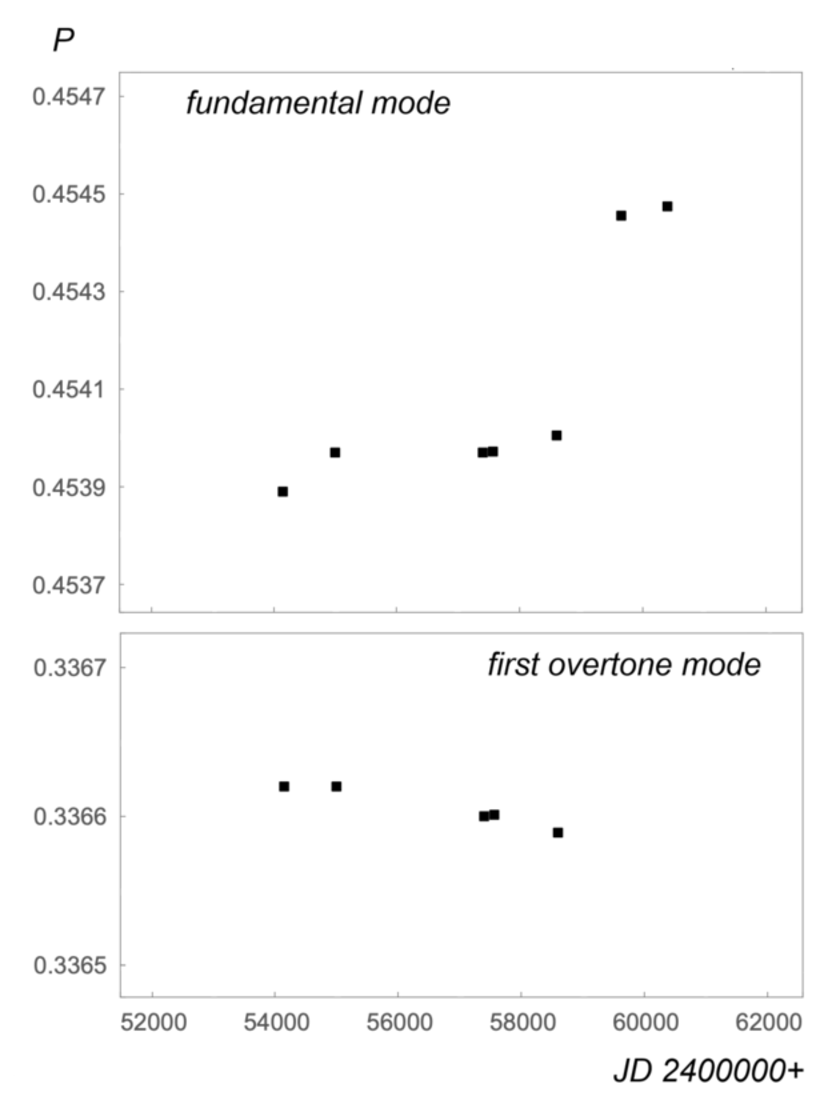 |
Fig. 9. Period variations of V5845 Sgr. Top: the fundamental-mode period, bottom: the first-overtone period. |
Acknowledgments: The author wishes to thank Dr. V.P.
Goranskij for providing his software. The study was conducted
under the state assignments of Lomonosov Moscow State University
and of Institute of Astronomy (Russian Academy of Sciences).
References:
Bellm, E. C., Kulkarni, S. R., & Graham, M. J. 2019, Publ. Astron. Soc. Pacific, 131, 018002
Butters, O. W., West, R. G., Anderson, D. R., et al. 2010, Astron. & Astrophys., 520, L10
Deeming, T. J. 1975, Astrophys. & Space Sci., 36, 137
Drake, A. J., Djorgovski, S. G., Mahabal, A., et al. 2009, Astrophys. J., 696, 870
Drake, A. J., Graham, M. J., & Djorgovski, S. G. 2014, Astrophys. J. Suppl. Ser., 213, article id. 9
Drake, A. J., Djorgovski, S. G., Catelan M., et al. 2017, Mon. Notices Roy. Astron. Soc., 469, 3688
Gaia Collaboration 2018, Vizier On-line Data Catalog: I/345
Gaia Collaboration 2022a, VizieR On-line Data Catalog: I/355/epphot
Gaia Collaboration 2022b, Vizier On-line Data Catalog: I/358
Goranskij, V. P., Clement, C. M., & Thompson, M. 2010, in: ?Variable Stars, the Galactic halo and Galaxy Formation?, Eds. Sterken, C., Samus, N. & Szabados, L., Moscow: Sternberg Astronomical Institute of Moscow Univ., p. 115
Heinze, A. N., Tonry, J. L., Denneau, L., et al. 2018, Astron. J., 156, article id. 241
Jayasinghe, T., Stanek, K. Z., Kochanek, C. S., et al. 2019, Mon. Notices Roy. Astron. Soc., 486, 1907
Kains, N., Bramich, D. M., Arellano Ferro, A., & Figuera Jaimes, R. 2015, Astron. & Astrophys., 582, id. A119
Kaluzny, J., Hilditch, R. W., Clement, C., & Rucinski, S. M. 1998, Mon. Notices Roy. Astron. Soc., 296, 347
Kazarovets, E. V., Samus, N. N., Durlevich, O. V., Kireeva, N. N., Pastukhova, E. N. 2015, Inform. Bull. on Var. Stars, No. 6155, 1
Kazarovets, E. V. & Pastukhova, E. N. 2017, Perem. Zvezdy Prilozh., 17, No. 2
Kazarovets, E. V., Samus, N. N., Durlevich, O. V., et al. 2019, Perem. Zvezdy, 39, No. 3
Keller, S. C., Murphy, S., Prior, S., et al. 2008, Astrophys. J., 678, 851
Kukarkin, B. V., Kholopov, P. N., Artiukhina, N. M., et al. 1982, New Catalogue of Suspected Variable Stars, Moscow: "Nauka"
Khruslov, A. V. 2014, Perem. Zvezdy, 34, No. 3
Khruslov, A. V. 2023, Perem. Zvezdy, 43, No. 7
Khruslov, A. V., Kusakin, A. V., & Reva, I. V. 2017, Acta Astron., 67, 317
Kochanek, C. S., Shappee, B. J., Stanek, K. Z., et al. 2017, Publ. Astron. Soc. Pacific, 129, 104502
Lafler, J. & Kinman, T. D. 1965, Astrophys. J. Suppl., 11, 216
Luyten, W. J. 1937, Astron. Nachrichten, 261, 451
Malanchev, K. L., Pruzhinskaya, M. V., Korolev, V. S., et al. 2021, Mon. Notices Roy. Astron. Soc., 502, 5147
Masci, F. J., Laher, R. R., Rusholme, B., et al. 2019, Publ. Astron. Soc. Pacific, 131, 018003
Poleski, R. 2014, Publ. Astron. Soc. Pacific, 126, 509
Samus, N. N., Kazarovets, E. V., Durlevich, O. V., Kireeva, N. N., Pastukhova, E. N. 2017, Astron. Rep., 61, No.1, 80
Sesar, B., Hernitschek, N., Mitrovic, S., et al. 2017, Astron. J., 153, article id. 204
Shappee, B. J., Prieto, J. L., Grupe, D., et al. 2014, Astrophys. J., 788, 48
Sokolovsky, K. V. 2007, Perem. Zvezdy Prilozh., 7, No. 30
Soszynski, I., Dziembowski, W. A., Udalski, A., et al. 2014a, Acta Astron., 64, 1
Soszynski, I., Udalski, A., Szymanski, M. K., et al. 2014b, Acta Astron., 64, 177
Zhang, J., Chen, X., Wang, S., et al. 2025, Astrophys. J. Suppl. Ser., 281, 38