APOD: 2026 March 31 Б Uranus Largest Moon: Titania
Explanation:
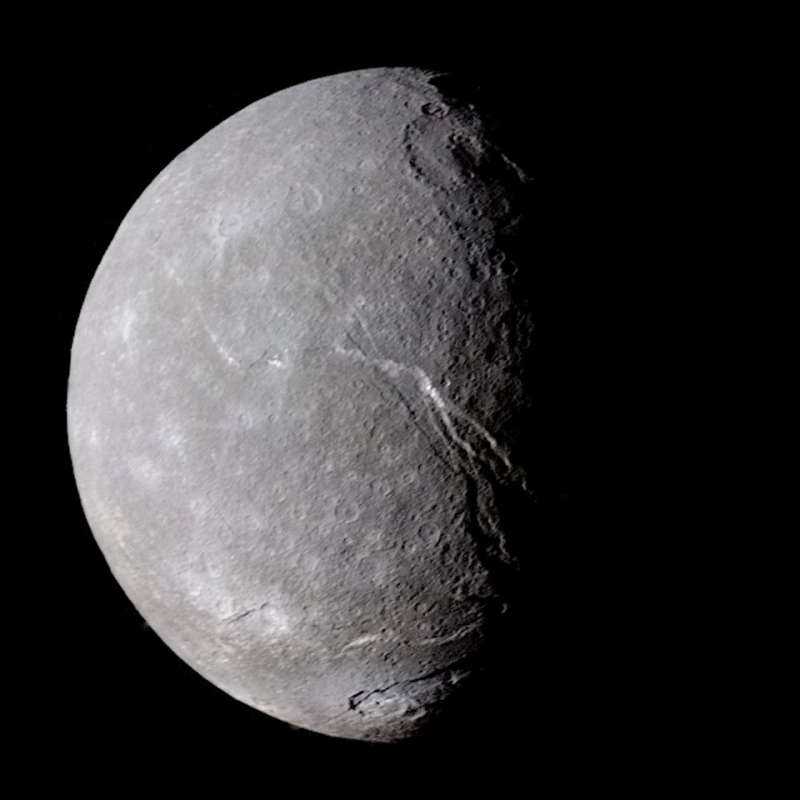
Titania's tortured terrain is a mix of canyons, cliffs, and craters.
NASA's interplanetary robot spacecraft
Voyager 2 passed the largest moon of
Uranus in 1986 and took the
feature picture.
That the
trenches of Titania
resemble those on another moon of Uranus,
Ariel,
indicate that Titania underwent some violent surface
event possibly related to water
freezing and expanding in its distant past.
Although Titania is Uranus's largest moon,
it is only about half the radius of
Triton -
the largest moon of Uranus's sister planet
Neptune,
which itself is
slightly smaller than
Earth's Moon.
Titania,
discovered by
William Herschel
in 1787, is essentially a large dirty iceball
that is composed of about half water-ice and half rock.
There is recent
speculation
that
radioactive heating
melts some underground ice into oceans.
Authors & editors:
Robert Nemiroff
(MTU) &
Jerry Bonnell
(USRA)
NASA Web Site Statements, Warnings,
and Disclaimers
NASA Official: Jay Norris.
Specific
rights apply.
A service of:
LHEA at
NASA /
GSFC
& Michigan Tech. U.

